Collagen: Mechanisms, Evidence, Dosage, and Clinical Use (Evidence-Based Guide)
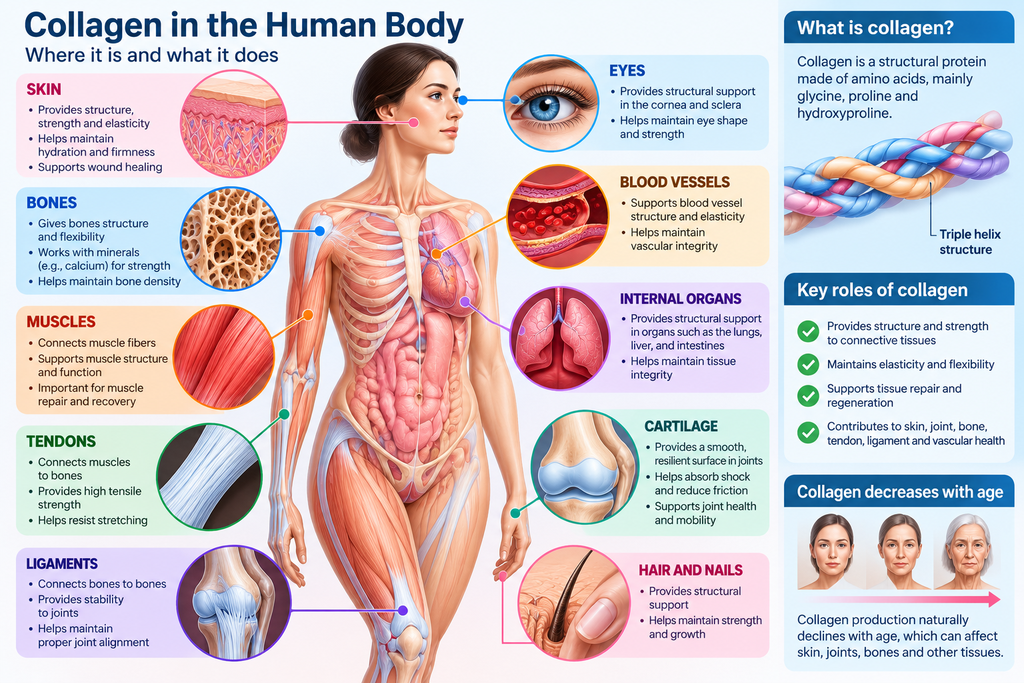
Collagen is the most abundant structural protein in the human body and an important component of skin, cartilage, tendons, ligaments, bones, and other connective tissues.
Collagen supplements are widely marketed for joint health, skin aging, exercise recovery, and connective-tissue support. However, collagen products are not all the same. Hydrolyzed collagen peptides, gelatin, and undenatured type II collagen have different structures, doses, and proposed mechanisms.
Evidence suggests that some oral collagen preparations may improve joint symptoms and may modestly improve certain skin parameters, but results vary by product, dose, population, and study quality.
What Is Collagen?
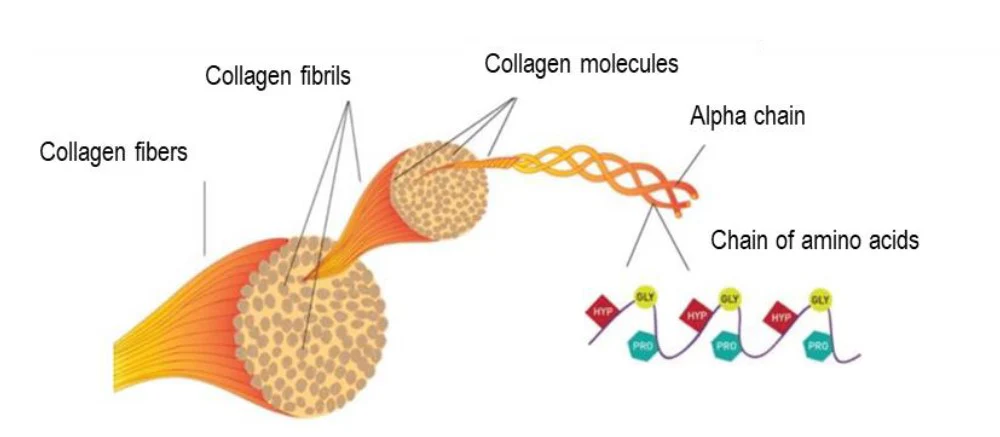
Collagen is a protein made primarily from amino acids including glycine, proline, and hydroxyproline.
It provides structural support throughout the body and is particularly important for:
- Skin
- Cartilage
- Tendons
- Ligaments
- Bones
- Connective tissue
The body continuously produces and breaks down collagen. Collagen production also changes with age and can be influenced by factors such as nutrition, hormonal changes, smoking, ultraviolet exposure, and overall health.
When collagen is consumed orally, it is digested into amino acids and small peptides. Dietary collagen does not simply travel intact to the skin or joints. Its potential effects may involve both the availability of amino acids and signaling effects from collagen-derived peptides.
Types of Oral Collagen Supplements
Several forms of collagen are available commercially, but they should not be considered interchangeable.
Hydrolyzed Collagen Peptides
Hydrolyzed collagen has been broken down enzymatically into smaller peptides.
It is commonly used in powders, capsules, drinks, and functional foods.
Collagen peptides are the most versatile oral form and have been studied for:
- Skin hydration and elasticity
- Joint comfort
- Osteoarthritis symptoms
- Exercise-related connective-tissue support
Gelatin
Gelatin is produced by partial hydrolysis of collagen.
It is widely used as a food ingredient and contains collagen-derived amino acids and peptides.
Gelatin can contribute to dietary protein intake, but clinical evidence for specific health outcomes varies.
Undenatured Type II Collagen (UC-II)
UC-II is a different type of collagen preparation. It contains undenatured type II collagen, meaning its original molecular structure is largely preserved.
It is usually taken in a much smaller amount than collagen peptides.
UC-II has been studied particularly for:
- Joint comfort
- Osteoarthritis symptoms
- Joint function
A commonly studied amount is approximately 40 mg/day, depending on the specific preparation.
Importantly, 40 mg of UC-II should not be compared directly with 10 g of collagen peptides. They are different preparations with different proposed mechanisms.
Collagen Supplements: Comparison Table
| Form | What It Is | Typical Studied Amount | Main Areas Studied | Practical Use |
|---|---|---|---|---|
| Hydrolyzed collagen peptides | Collagen broken into smaller peptides | ~2.5–15 g/day | Skin, joints, connective tissue | Most versatile oral collagen |
| Gelatin | Partially hydrolyzed collagen | Variable | Protein/connective tissue nutrition | Food-based collagen source |
| Undenatured type II collagen (UC-II) | Native type II collagen | ~40 mg/day | Joint comfort and function | Joint-specific option |
| Native collagen | Structurally intact collagen | Variable | Mainly research/food applications | Not interchangeable with collagen peptides |
| Collagen-rich foods | Naturally occurring collagen in animal tissues | Variable | General nutrition | Food-first option |
Which Type of Collagen Is Best for Different Goals?
There is no single collagen product that is proven to be best for everyone. The evidence depends on the specific preparation and the outcome being studied.
| Goal | Collagen Form With Relevant Evidence | Typical Studied Dose | Evidence | Important Point |
|---|---|---|---|---|
| Skin hydration | Hydrolyzed collagen peptides | ~2.5–10 g/day | Mixed/modest | Some studies report improved hydration |
| Skin elasticity | Hydrolyzed collagen peptides | ~2.5–10 g/day | Mixed/modest | Results vary between studies |
| Joint discomfort | Collagen peptides or specific collagen preparations | Varies | Moderate | Some studies report improved pain or function |
| Osteoarthritis symptoms | Collagen peptides / specific collagen preparations | Varies | Moderate | Evidence is promising but heterogeneous |
| Joint-specific support | UC-II | ~40 mg/day | Moderate, preparation-specific | Do not extrapolate evidence to every type-II collagen |
| Exercise/connective tissue | Collagen peptides | Often ~10–15 g/day | Limited to moderate | May be most relevant when combined with exercise |
| Bone health | Collagen peptides | Variable | Emerging | More research is needed |
| General protein intake | Collagen peptides or gelatin | Variable | Not a special advantage | Collagen is not a complete protein |
How Does Oral Collagen Work?
Several mechanisms have been proposed.
1. Provides Amino Acids
Collagen provides large amounts of glycine, proline, and hydroxyproline.
These amino acids are used in the body’s normal protein and connective-tissue metabolism.
2. Provides Collagen-Derived Peptides
Digestion produces smaller collagen-derived peptides that can enter the circulation.
Some of these peptides may interact with cells involved in connective-tissue metabolism.
3. May Influence Extracellular-Matrix Activity
Some collagen-derived peptides may act as signaling molecules that influence fibroblast activity and extracellular-matrix processes.
However, this does not mean that every collagen supplement directly increases collagen production to the same degree.
Collagen for Joint Health
Joint health is one of the most studied applications of oral collagen.
Collagen is an important component of cartilage and other connective tissues surrounding joints.
Clinical studies have investigated collagen supplementation in people with:
- Knee osteoarthritis
- Joint discomfort
- Exercise-related joint stress
- Age-related joint problems
A 2024 systematic review and meta-analysis of randomized controlled trials found improvements in knee osteoarthritis pain and function with oral collagen-based supplementation, although the studies differed considerably in their products, doses, populations, and methods.
Evidence: Moderate
Collagen may help reduce joint discomfort or improve function in some individuals, but it should not be considered a replacement for medical treatment of osteoarthritis.
Exercise, weight management when appropriate, physical therapy, and other evidence-based treatments remain important components of joint care.
Collagen for Skin Health
Collagen supplements are widely marketed for:
- Skin hydration
- Skin elasticity
- Fine lines
- Skin aging
Several clinical trials and earlier meta-analyses have reported modest improvements in skin hydration and elasticity following several weeks of collagen supplementation.
However, the evidence is not completely consistent.
A 2025 meta-analysis raised concerns about the strength of the evidence, finding that apparent benefits were less convincing when analyses were restricted to higher-quality or non-industry-funded studies.
Evidence: Mixed / Modest
Collagen peptides may improve some skin parameters, but the effect should not be presented as guaranteed or equivalent to medical or cosmetic procedures.
Collagen for Muscle and Connective Tissue
Collagen supplementation has also been studied in physically active individuals.
Collagen provides amino acids that are important for connective tissue, but it has a relatively low amount of leucine compared with high-quality complete proteins such as whey or dairy protein.
For this reason, collagen should not be considered a replacement for adequate dietary protein when the primary goal is muscle protein synthesis.
Some research suggests collagen supplementation may be useful when combined with resistance training or mechanical loading, particularly for connective-tissue support.
Evidence: Limited to Moderate
More research is needed to determine which populations, doses, and exercise protocols benefit most.
Collagen and Bone Health
Collagen forms an important structural component of bone.
Preliminary research suggests that collagen peptides may influence markers related to bone metabolism and may potentially support bone health.
However, the evidence is less established than that for joint-related outcomes.
Evidence: Emerging
Collagen should not replace established treatments for osteoporosis or other bone diseases.
Adequate calcium, vitamin D, protein, resistance exercise, and appropriate medical management remain important for bone health.
Natural Sources of Collagen
Collagen occurs naturally in the connective tissues of animals.
Examples include:
| Food | Collagen Content | Practical Consideration |
|---|---|---|
| Bone broth | Can contain gelatin and collagen-derived proteins | Amount varies considerably by preparation |
| Chicken skin/connective tissue | Collagen-rich | Also relatively high in fat |
| Fish skin | Collagen-rich | Common source of marine collagen |
| Pork skin | Very collagen-rich | Often consumed as gelatin/skin |
| Beef connective tissue | Collagen-rich | Tendons and connective tissues contain substantial collagen |
| Gelatin | Derived from collagen | Convenient food-based source |
Does Eating Collagen-Rich Food Increase Collagen Directly?
Not exactly.
The digestive system breaks dietary collagen down into amino acids and peptides. These are then absorbed and used throughout the body.
Therefore, eating collagen does not mean that the collagen is transported directly to your skin or joints.
A balanced diet that provides sufficient protein and micronutrients supports the body’s normal collagen production.
Vitamin C and Collagen
Vitamin C is essential for normal collagen biosynthesis.
It participates in enzymatic reactions required for the formation and stabilization of collagen.
Good dietary sources include:
- Citrus fruits
- Kiwi
- Strawberries
- Bell peppers
- Broccoli
- Tomatoes
Collagen + Vitamin C
Combining collagen with adequate vitamin C intake is biologically reasonable because vitamin C is required for normal collagen formation.
However, this does not mean that taking high-dose vitamin C with collagen automatically produces greater clinical benefits.
For most people, obtaining adequate vitamin C from a balanced diet is sufficient.
Collagen Combinations
Collagen is often combined with other nutrients or supplements.
| Combination | Potential Purpose | Evidence / Comment |
|---|---|---|
| Collagen peptides + Vitamin C | Supports normal collagen biosynthesis | Biologically logical; high-dose vitamin C is not necessarily required |
| Collagen + Resistance Training | Connective tissue and exercise support | May be useful as part of an exercise program |
| Collagen + Hyaluronic Acid | Skin hydration | Some products combine them; evidence is product-specific |
| Collagen + Vitamin D | Bone/musculoskeletal health | Useful when vitamin D intake/status is inadequate |
| Collagen + Calcium | Bone nutrition | May be appropriate when dietary calcium is inadequate |
| Collagen + Glucosamine/Chondroitin | Joint support | Different mechanisms; combination evidence varies |
| Collagen + Protein Powder | Overall protein intake | Can complement collagen because collagen is an incomplete protein |
| Collagen + UC-II | Joint support | Not automatically superior; they are different collagen preparations |
More Supplements Do Not Necessarily Mean Better Results
Taking several collagen products simultaneously does not automatically provide additional benefits.
For example, combining:
- Collagen peptides
- Marine collagen
- Type I/III collagen
- UC-II
does not have established evidence of being superior to an appropriately selected single preparation.
Clinical research generally evaluates specific preparations, doses, and combinations.
Collagen vs Protein Powder
One important misconception is that collagen is equivalent to whey or another complete protein.
| Feature | Collagen Peptides | Whey / Complete Protein |
|---|---|---|
| Main role | Connective-tissue-focused protein source | General protein and muscle nutrition |
| Glycine | High | Lower |
| Proline | High | Lower |
| Leucine | Relatively low | High |
| Essential amino-acid profile | Incomplete | Complete |
| Muscle protein synthesis | Less effective as a sole protein source | Stronger evidence |
| Connective-tissue interest | High | General protein support |
| Should replace dietary protein? | No | Can contribute substantially to protein requirements |
Bottom line: Collagen can complement a balanced protein intake, but it should not replace high-quality complete protein when muscle maintenance or growth is the primary goal.
Collagen Dosage
There is no single universally established collagen dose because studies use different preparations and target different outcomes.
Hydrolyzed Collagen Peptides
Commonly studied amounts range from approximately:
2.5–15 g per day
For skin studies, doses around 2.5–10 g/day are common.
For joint and exercise-related applications, some studies use approximately 10–15 g/day.
UC-II
A commonly studied amount for specific undenatured type II collagen preparations is:
Approximately 40 mg/day
Again, this dose should not be compared directly with several grams of collagen peptides because the products have different structures and proposed mechanisms.
Follow the Product Instructions
The appropriate dose can depend on:
- Collagen preparation
- Specific strain/source
- Intended use
- Clinical study supporting the product
- Other ingredients in the formulation
When Should You Take Collagen?
There is no strong evidence that collagen must be taken in the morning or at night.
Collagen peptides can generally be taken at a convenient time of day.
For people using collagen around exercise, some research has investigated intake before exercise or mechanical loading, but this does not establish a universal requirement for precise timing.
Practical approach
Choose a time that makes consistent daily use easy.
Collagen can be mixed into:
- Water
- Coffee
- Smoothies
- Yogurt
- Oatmeal
- Other foods or drinks
Follow the manufacturer’s instructions regarding preparation and storage.
How Long Does Collagen Take to Work?
Collagen is not an immediate-effect supplement.
Skin
Studies commonly evaluate outcomes after approximately 8–12 weeks or longer.
Potential changes in hydration or elasticity, when they occur, are generally gradual.
Joints
Joint studies commonly evaluate outcomes over several weeks to months.
A person should not expect collagen to work like an immediate pain reliever.
Important
Individual responses vary, and not everyone will experience a noticeable benefit.
Safety and Side Effects
Collagen supplements are generally well tolerated in clinical studies.
Possible side effects include:
- Mild digestive discomfort
- Fullness
- Unpleasant taste
- Bloating in some individuals
Allergic reactions are uncommon but possible.
Check the Source
Collagen may be derived from:
- Fish
- Bovine sources
- Porcine sources
- Chicken
People with known allergies should check the source carefully.
People who avoid particular animal-derived ingredients for dietary, ethical, or religious reasons should also check the product label.
Who Should Be Cautious?
Speak with a healthcare professional before using collagen supplements if you:
- Have a known allergy to the source of the collagen
- Have a significant medical condition
- Are pregnant or breastfeeding and considering high-dose supplementation
- Are taking multiple supplements or medications
- Are using collagen as an alternative to prescribed treatment for a joint or bone condition
Collagen should be considered a supplement to appropriate nutrition and medical care, not a treatment replacement.
| Collagen source | Typical form | Bioavailability | What the evidence suggests |
|---|---|---|---|
| Marine / fish | Hydrolyzed collagen peptides | High | Often described as highly bioavailable, but human comparisons do not establish clear overall superiority |
| Bovine | Hydrolyzed collagen peptides | High | Well studied; produces substantial circulating collagen-derived peptides |
| Porcine | Hydrolyzed collagen peptides | High | Also efficiently absorbed; some human data show comparable or even higher uptake of certain markers |
| Chicken | Often type II collagen | High when hydrolyzed | Particularly relevant to cartilage/joint-focused products; evidence depends on the preparation |
| UC-II | Undenatured type II collagen | Different mechanism | Should not be compared with hydrol |
Marine collagen is often marketed as having superior bioavailability, but current human evidence does not establish that marine collagen is consistently better absorbed or more effective than high-quality hydrolyzed bovine or porcine collagen. The degree of hydrolysis, peptide size and specific peptide composition may be more important determinants of absorption and biological activity than the animal source alone.
Don’t choose collagen primarily by “marine vs bovine.” Choose a well-characterized hydrolyzed collagen peptide product with:
- Hydrolyzed collagen peptides
- Clearly stated grams per serving
- Ideally information about peptide size/composition
- A source you tolerate and are comfortable using
- Evidence relevant to your intended goal
And if the purpose is specifically joint support, don’t automatically choose marine collagen simply because of a “better absorption” marketing claim. The specific preparation and clinical evidence are more important.
Limitations of Collagen Supplements
Collagen supplementation has several limitations.
1. Results Are Not Guaranteed
Clinical trials show variable results.
2. Products Differ
Different collagen products may differ in:
- Source
- Molecular size
- Degree of hydrolysis
- Collagen type
- Dose
- Additional ingredients
Evidence for one preparation should not automatically be applied to another.
3. Skin Evidence Is Mixed
Although several studies report improvements in skin hydration and elasticity, more recent analysis has questioned how strong the evidence is when study quality and funding are considered.
4. Collagen Is Not a Complete Protein
It is relatively low in certain essential amino acids, particularly compared with high-quality complete proteins.
5. It Is Not a Painkiller
Collagen does not provide the immediate analgesic effect of a conventional pain-relieving medicine..
Conclusion
Collagen supplementation may support connective tissue structure and joint health, with moderate evidence for improvements in joint comfort and skin parameters.
Evidence summary:
Moderate evidence supports collagen’s role in joint comfort and skin health, particularly with long-term use. Effects are gradual and more pronounced in individuals with increased connective tissue demand.
Is collagen actually absorbed?
Yes. Oral collagen is digested and absorbed as amino acids and small peptides. Some collagen-derived peptides can appear in the circulation after ingestion.
However, absorption does not mean that intact collagen travels directly to a particular tissue.
Is hydrolyzed collagen better than regular collagen?
Hydrolyzed collagen is broken down into smaller peptides before consumption and is widely used in oral supplements.
However, “better absorbed” does not automatically mean “clinically more effective.” The outcome depends on the specific preparation and the condition being studied.
Is marine collagen better than bovine collagen?
There is not enough evidence to say that marine collagen is universally better than bovine collagen.
Both can provide collagen peptides, but the source, peptide composition, dose, product quality, and clinical evidence matter.
Is collagen good for joints?
Some evidence suggests that oral collagen preparations can improve joint discomfort and function, particularly in people with osteoarthritis.
However, results vary and collagen should not replace established treatments.
Is collagen good for skin?
Some studies report improvements in skin hydration and elasticity after several weeks of collagen supplementation.
However, the evidence is mixed, and the magnitude of benefit appears modest.
Does collagen help hair growth?
There is currently insufficient clinical evidence to conclude that oral collagen directly promotes hair growth.
Collagen provides amino acids and may support general protein nutrition, but this should not be presented as a proven hair-growth treatment.
Can I take collagen every day?
Collagen is commonly used daily in clinical studies.
Long-term use should still be considered in the context of the specific product, dose, health status, and overall diet.
Should collagen be taken with vitamin C?
Adequate vitamin C is necessary for normal collagen formation.
Taking collagen with a vitamin-C-containing meal or ensuring adequate vitamin C intake through the diet is reasonable.
There is not strong evidence that everyone needs a high-dose vitamin C supplement with collagen.
Can collagen replace protein powder?
No.
Collagen is an incomplete protein and is relatively low in leucine and some essential amino acids.
If your primary goal is muscle protein synthesis, a complete protein source such as dairy, eggs, meat, soy, or an appropriate complete protein supplement is generally more suitable.
Is UC-II the same as collagen peptides?
No.
UC-II is an undenatured type II collagen preparation, while collagen peptides are hydrolyzed into smaller peptides.
They are studied at very different doses and may work through different mechanisms.
Evidence Summary
Joint health: Moderate evidence suggests that some oral collagen preparations may improve joint discomfort and function, particularly in osteoarthritis, although studies vary in their products and methods.
Skin health: Evidence is mixed. Some studies and earlier meta-analyses report modest improvements in hydration and elasticity, but more recent analyses have raised concerns about study quality and industry funding.
Muscle and connective tissue: Evidence is limited to moderate. Collagen may complement exercise and adequate nutrition but is not a replacement for complete protein.
Bone health: Evidence is emerging and requires further research.
Overall: Collagen can be a reasonable supplement for selected individuals, particularly when the goal is joint or connective-tissue support. However, benefits are generally modest, gradual, and dependent on the specific collagen preparation.
Key Takeaways
- Hydrolyzed collagen peptides are the most versatile oral collagen preparation.
- UC-II is a different, undenatured type II collagen preparation primarily studied for joint health.
- Collagen peptides are commonly used at approximately 2.5–15 g/day, depending on the purpose.
- UC-II is commonly studied at approximately 40 mg/day for specific preparations.
- Collagen is digested into amino acids and small peptides rather than traveling intact to the skin or joints.
- Adequate vitamin C is important for normal collagen synthesis.
- Natural collagen sources include fish skin, chicken skin, connective tissue, gelatin, and bone broth.
- Collagen is not a complete protein and should not replace high-quality dietary protein.
- More collagen products or more strains/types do not automatically mean better results.
- Skin benefits appear modest and uncertain, while evidence for certain joint outcomes is more consistent.
- Collagen should complement—not replace—appropriate nutrition, exercise, and medical treatment.
Clinical Note
This article is for informational purposes only and does not constitute medical advice. Collagen supplements may support certain aspects of connective-tissue health, but they do not diagnose, prevent, or treat medical conditions. People with persistent joint pain, significant mobility problems, unexplained bone loss, or other concerning symptoms should seek appropriate medical evaluation.
Related guides: