
Calcium Deficiency: Symptoms, Causes, Treatment, Supplements & Dosage
Calcium is one of the most abundant minerals in the body and is essential for maintaining strong bones and teeth. It also supports muscle contraction, nerve signaling, and hormone secretion.
When calcium intake is insufficient, the body may draw calcium from bones to maintain normal blood levels. Over time this can weaken bones and lead to various health problems.
Calcium is best known for keeping bones and teeth strong, but its role in the body goes much further.
Calcium is essential for muscle contraction, nerve signaling, blood clotting and normal heart and cellular function. Most calcium is stored in the skeleton, while a small amount circulates in the blood and is tightly regulated by hormones and other nutrients.
A low calcium intake over time can contribute to poor bone health. However, low calcium intake and low blood calcium are not exactly the same thing.
When blood calcium becomes abnormally low — a condition called hypocalcemia — symptoms can range from tingling and muscle cramps to severe spasms, seizures and abnormal heart rhythms.
Understanding the difference is important before starting a calcium supplement.
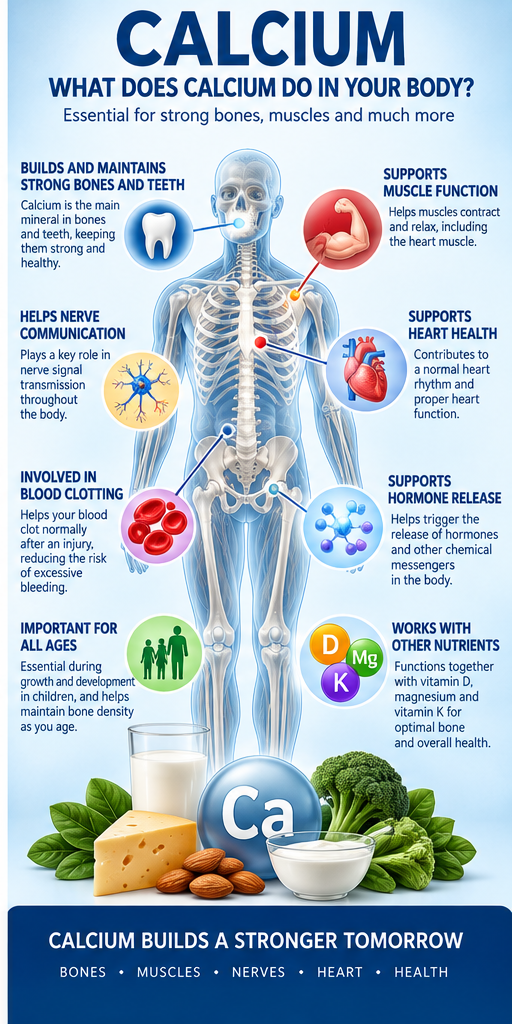
What Does Calcium Do in the Body?
Calcium is the most abundant mineral in the human body.
About 99% of the body’s calcium is stored in the bones and teeth, where it contributes to their structure and strength.
The remaining calcium circulates in the blood and tissues and performs several essential functions.
Calcium is needed for:
- Bone and teeth strength
- Muscle contraction
- Nerve transmission
- Normal heart function
- Blood clotting
- Cell signaling
- Normal enzyme and hormone-related processes
Calcium also acts as a reservoir in bone. When blood calcium needs to be maintained, the body can adjust calcium movement between bone, the kidneys and the digestive system. Parathyroid hormone (PTH), vitamin D and other mechanisms help regulate this balance.
This is why calcium deficiency can affect more than bones.
When blood calcium is significantly low, the nervous and muscular systems can become unusually excitable, causing symptoms such as tingling, muscle cramps and spasms.
Calcium Does Not Work Alone: Nutrients That Help Calcium Absorption & Utilization
Calcium metabolism depends on several vitamins and minerals working together.
Getting enough calcium is important, but the body also needs nutrients involved in calcium absorption, transport, regulation and bone mineralization.
The most important ones are vitamin D, magnesium and vitamin K.
Vitamin D — Essential for Calcium Absorption
Vitamin D is probably the most important nutrient to consider alongside calcium.
Your small intestine needs vitamin D to efficiently absorb calcium from food and supplements. Vitamin D also helps maintain normal calcium levels in the blood.
When vitamin D status is low, calcium absorption decreases.
This means that someone can consume plenty of calcium but still have problems maintaining calcium balance if vitamin D status is inadequate.
Vitamin D + Calcium
This is why calcium and vitamin D are frequently combined in supplements.
However, more vitamin D is not necessarily better.
The goal is adequate vitamin D status, not high-dose vitamin D supplementation without a reason.
👉 Read our guide: Vitamin D Deficiency — Symptoms, Causes, Dosage & Safety
Magnesium — Helps Regulate Calcium
Magnesium has an important role in normal calcium metabolism.
It contributes to bone structure and is involved in the regulation of parathyroid hormone and calcium balance. Severe magnesium deficiency can lead to low calcium levels and make hypocalcemia difficult to correct until the magnesium deficiency is addressed.
Magnesium is also important for maintaining healthy bone tissue.
This does not mean that everyone taking calcium needs a magnesium supplement.
If your diet already provides sufficient magnesium, additional supplementation may not be necessary.
Calcium + Magnesium
A combination containing calcium and magnesium can be convenient, particularly when dietary intake of both nutrients is inadequate.
However, check the amounts carefully if you already take a separate magnesium supplement.
👉 Read: Magnesium Deficiency — Symptoms, Causes & Treatment
Vitamin K — Important for Calcium-Related Bone Proteins
Vitamin K has a different role.
It is required for the activation of several vitamin K-dependent proteins, including osteocalcin, a protein found in bone, and matrix Gla-protein (MGP), which is present in blood vessels and other tissues.
Osteocalcin is involved in bone metabolism, while MGP is being studied for its role in regulating abnormal calcification in vascular tissue.
This has led to a popular claim that:
“Vitamin K2 directs calcium into the bones and keeps it out of the arteries.”
The biology behind this idea is interesting, but this statement is too simplistic to present as an established clinical fact.
Vitamin K clearly plays an important biochemical role in bone and vascular proteins, but whether vitamin K supplementation prevents cardiovascular calcification or significantly improves bone outcomes remains an area of ongoing research. Studies of vitamin K supplements and bone health have produced mixed results.
Vitamin K and Calcium: Bone Health, Blood Clotting & Safety
Vitamin K is another nutrient involved in calcium metabolism and bone health, but its role is more complex than the common claim that vitamin K2 simply “puts calcium into bones and keeps it out of arteries.”
Vitamin K is required for the activation of several vitamin K-dependent proteins, including proteins involved in blood clotting and proteins involved in bone and vascular biology. These include prothrombin (clotting factor II), osteocalcin and matrix Gla-protein (MGP). (NIH Office of Dietary Supplements)
Vitamin K and bone health
Vitamin K-dependent proteins are involved in normal bone metabolism. Osteocalcin, for example, is produced by bone-forming cells and requires vitamin K for activation.
This is one reason vitamin K, particularly vitamin K2 forms such as MK-7 and MK-4, is often included in calcium and bone-health supplements.
However, it is important not to overstate the evidence.
Although vitamin K has a clear biological role in bone metabolism, clinical research has not established that taking vitamin K2 supplements automatically improves bone density, prevents fractures or directs calcium away from blood vessels. Research into vitamin K supplementation and bone health is ongoing. (NIH Office of Dietary Supplements)
What about calcium and arteries?
You may have seen the claim:
“Vitamin K2 puts calcium into bones and keeps it out of the arteries.”
The underlying biology is more complicated.
Vitamin K is required for activation of matrix Gla-protein (MGP), a protein involved in the regulation of abnormal calcification in tissues. This has led to considerable interest in vitamin K2 and vascular calcification.
However, it has not been proven that taking vitamin K2 supplements prevents arterial calcification or cardiovascular disease by redirecting calcium into bone.
Therefore, calcium supplements should not be combined with high-dose vitamin K2 simply on the assumption that K2 will prevent calcium from accumulating in blood vessels.
Vitamin K and blood clotting
Vitamin K is essential for normal blood coagulation. The liver requires vitamin K to produce functional clotting factors, including prothrombin (factor II).
This does not mean that normal dietary vitamin K automatically causes thrombosis. Vitamin K is a normal and essential nutrient, and inadequate vitamin K can actually impair normal blood clotting and increase bleeding risk. (NIH Office of Dietary Supplements)
The major safety issue is its interaction with vitamin K-antagonist anticoagulants.
Important: Warfarin and other vitamin K antagonists
If you take:
- Warfarin
- Acenocoumarol
- Phenprocoumon
- Another vitamin K-antagonist anticoagulant
do not start, stop or substantially increase a vitamin K supplement without medical advice.
Vitamin K can reduce the anticoagulant effect of these medicines.
Importantly, people taking warfarin are generally advised to maintain a consistent intake of vitamin K, rather than completely avoiding vitamin K-containing foods. Sudden changes in vitamin K intake can affect anticoagulation control. (NIH Office of Dietary Supplements)
What about other anticoagulants?
The interaction above is particularly important with vitamin K-antagonist medicines such as warfarin.
Do not assume that every blood thinner interacts with vitamin K in the same way. Medicines such as apixaban, rivaroxaban and dabigatran work through different mechanisms.
Nevertheless, if you take any anticoagulant or antiplatelet medication, check with your pharmacist or doctor before adding a vitamin K supplement, especially a high-dose product.
Bottom line
Vitamin K is important for normal blood clotting and is involved in bone metabolism and vascular calcification biology.
However, vitamin K2 should not be presented as a proven “calcium traffic controller” that automatically puts calcium into bones and prevents it from entering arteries.
For most people, the priority is a balanced diet that provides adequate vitamin K, together with appropriate calcium, vitamin D and magnesium intake.
If you take warfarin or another vitamin K-antagonist anticoagulant, consult your healthcare professional before changing your vitamin K intake or starting a vitamin K-containing supplement.
Calcium, Vitamin D, Magnesium & Vitamin K: How They Work Together
| Nutrient | Main role related to calcium |
|---|---|
| Calcium | Provides the mineral used in bones and teeth and participates in nerve, muscle and other functions |
| Vitamin D | Helps the intestine absorb calcium and maintain calcium balance |
| Magnesium | Supports bone health and calcium regulation; severe deficiency can contribute to hypocalcemia |
| Vitamin K | Activates proteins involved in bone metabolism and vascular calcification regulation |
| Phosphorus | Combines with calcium to form the mineral matrix of bone |
The simple picture
Vitamin D → helps calcium get absorbed
Magnesium → helps regulate calcium balance and supports bone metabolism
Vitamin K → activates proteins involved in bone mineralization and calcium-related tissue regulation
Calcium + phosphorus → form the mineral structure of bone
This is why bone health is better understood as a nutrient network rather than a calcium-only problem.
What About Phosphorus?
Phosphorus deserves a brief mention because calcium and phosphorus form the mineral component of bone, primarily as hydroxyapatite. More than 99% of the body’s calcium is stored in bones and teeth in this mineralized form.
However, phosphorus deficiency is uncommon in people eating a normal diet, and taking phosphorus supplements is generally not a strategy for improving calcium absorption.
The focus should be on maintaining a balanced diet rather than adding phosphorus supplements.
What About Zinc, Boron and Other Minerals?
Some calcium and bone-health formulas also contain:
- Zinc
- Copper
- Manganese
- Boron
- Silicon
These minerals participate in various aspects of connective tissue, bone formation and mineral metabolism.
However, the evidence is not strong enough to say that everyone taking calcium needs these nutrients as supplements.
A varied diet usually provides them.
For this reason, a product containing ten different “bone-support” ingredients is not automatically better than a simple calcium + vitamin D product.
The Best Approach to Calcium Supplementation
The goal should not be:
“Take calcium + vitamin D + magnesium + K2 + zinc + everything else.”
A better approach is:
1. Get adequate calcium
Prefer food sources whenever possible.
2. Ensure adequate vitamin D
Correct deficiency or inadequate intake when appropriate.
3. Get enough magnesium
Preferably through the diet unless supplementation is needed.
4. Maintain adequate vitamin K
A varied diet rich in green vegetables and other vitamin K-containing foods usually provides vitamin K.
5. Supplement selectively
Add individual nutrients when dietary intake is inadequate or there is a specific reason to supplement.
6. Avoid unnecessary high doses
More calcium, vitamin D, magnesium or vitamin K does not automatically mean stronger bones.
Important Safety Note About Vitamin K
If you take warfarin or another vitamin K-antagonist anticoagulant, do not suddenly start or stop a vitamin K supplement without discussing it with your healthcare professional.
Vitamin K can reduce the effectiveness of warfarin, and consistent vitamin K intake is important when using this medication.
Calcium Deficiency vs Low Blood Calcium: What’s the Difference?
These terms are sometimes used interchangeably, but they are not identical.
Inadequate calcium intake
This means you are not consuming enough calcium to meet your body’s needs.
Over time, inadequate intake can contribute to reduced bone mineralization and increase the risk of conditions such as osteoporosis.
Hypocalcemia
Hypocalcemia means that the calcium concentration in the blood is abnormally low.
This can happen even when a person consumes calcium because blood calcium is controlled by several systems involving:
- Parathyroid hormone
- Vitamin D
- Kidneys
- Magnesium
- Bone
- The digestive tract
Hypocalcemia may therefore indicate an underlying medical problem rather than simply “not eating enough calcium.”
Calcium Deficiency Symptoms
Mild or chronic low calcium may cause no obvious symptoms, particularly when blood calcium remains within the normal range.
When hypocalcemia becomes more significant, symptoms may include:
Early or common symptoms
- Tingling around the mouth
- Tingling or numbness in the fingers or toes
- Muscle cramps
- Muscle aches
- Muscle twitching
- Stiff muscles
- Fatigue
- Irritability
- Difficulty concentrating
The classic symptoms of clinically significant hypocalcemia are related to increased neuromuscular excitability.
More Severe Calcium Deficiency Symptoms
Severe hypocalcemia can cause:
- Painful muscle spasms
- Tetany
- Severe muscle stiffness
- Throat or airway spasms
- Seizures
- Confusion
- Abnormal heart rhythms
- In severe cases, loss of consciousness
Severe hypocalcemia can be a medical emergency.
Important
Do not assume that tingling, cramps or fatigue automatically mean you are calcium deficient.
These symptoms have many possible causes.
A blood test and evaluation of the underlying cause may be necessary.
Long-Term Effects of Inadequate Calcium
Inadequate calcium intake over a long period can contribute to poor bone mineralization.
Potential consequences include:
- Reduced bone mineral density
- Osteoporosis
- Increased fracture risk
- Osteomalacia in certain circumstances
- Rickets in children
Vitamin D deficiency is a more common cause of rickets and osteomalacia than calcium deficiency alone, but inadequate calcium can contribute.
Calcium deficiency can therefore be a silent problem.
You may not experience obvious symptoms until bone health has already been affected.
What Causes Calcium Deficiency?
There are several possible causes.
1. Not Enough Calcium in the Diet
This is one of the simplest causes.
Low intake may occur when someone:
- Rarely consumes dairy products
- Avoids dairy without replacing calcium-rich foods
- Follows a restrictive diet
- Has a poor overall diet
- Consumes few calcium-fortified foods
People who avoid dairy products are among the groups at greater risk of inadequate calcium intake.
2. Vitamin D Deficiency
Vitamin D is important for calcium absorption from the digestive tract.
If vitamin D status is inadequate, the body may absorb less calcium.
This is one reason calcium and vitamin D are frequently discussed together.
However:
Taking calcium does not automatically correct a vitamin D deficiency.
If vitamin D deficiency is present, it should be addressed appropriately.
3. Low Magnesium
Magnesium is involved in the regulation of parathyroid hormone and calcium balance.
Severe magnesium deficiency can contribute to hypocalcemia and may make it difficult to correct calcium levels until the magnesium problem is addressed.
This is one reason persistent low calcium should be medically investigated rather than treated simply by increasing calcium supplements.
4. Parathyroid Problems
The parathyroid glands produce parathyroid hormone (PTH), which helps regulate blood calcium.
Hypoparathyroidism can cause hypocalcemia.
It may occur after:
- Thyroid surgery
- Parathyroid surgery
- Damage to the parathyroid glands
- Certain autoimmune conditions
- Rare inherited disorders
Tingling around the mouth and muscle cramps are characteristic symptoms of hypocalcemia associated with hypoparathyroidism.
5. Kidney Disease
The kidneys play an important role in calcium and vitamin D metabolism.
Chronic kidney disease can disrupt calcium and phosphate balance and impair the activation of vitamin D.
As a result, kidney disease can contribute to low blood calcium and abnormal bone metabolism.
6. Problems Absorbing Calcium
Some gastrointestinal conditions can reduce nutrient absorption.
Examples include conditions that affect the digestive tract or cause significant malabsorption.
In these situations, simply taking a larger calcium dose may not solve the underlying problem.
What Can Reduce Calcium Absorption?
Getting enough calcium does not necessarily mean that all of it will be absorbed.
Calcium absorption depends on the form of calcium, the amount consumed at one time, vitamin D status, age, stomach acidity and the composition of the meal.
Several dietary factors can reduce calcium absorption.
1. Oxalates
Oxalic acid (oxalate) can bind calcium in the intestine and form compounds that are poorly absorbed.
Foods particularly high in oxalates include:
- Spinach
- Rhubarb
- Some leafy vegetables
- Sweet potatoes
- Some beans
This does not mean that you should avoid these foods.
For example, spinach contains calcium, but its calcium is poorly absorbed because of its high oxalate content. The NIH notes that calcium absorption from spinach is only around 5%, compared with approximately 27–30% from milk and many other calcium-containing foods.
Important:
A food can contain a lot of calcium on paper without providing the same amount of bioavailable calcium.
2. Phytates
Phytic acid (phytate) can also bind minerals, including calcium, reducing their absorption.
Phytates are found naturally in foods such as:
- Whole grains
- Seeds
- Nuts
- Legumes
However, this does not mean that whole grains, nuts or legumes are unhealthy.
Cooking, soaking, fermenting and food processing can reduce phytate levels, and when a person eats a varied diet, the overall nutritional effect is generally much less important than it may appear from looking at individual foods.
3. Very Large Calcium Doses at Once
The body does not absorb calcium with 100% efficiency.
In fact, the percentage absorbed decreases as the amount taken at one time increases.
Calcium absorption from supplements is highest with doses of approximately 500 mg or less at a time.
For example, if someone genuinely needs 1,000 mg of supplemental calcium per day, dividing it into two smaller doses may be preferable to taking the entire amount at once.
This is another reason why more calcium is not necessarily better.
4. Low Vitamin D
Vitamin D is required for efficient active calcium absorption in the intestine.
When vitamin D status is inadequate, calcium absorption decreases.
This is why correcting vitamin D deficiency may be important when calcium status is poor.
However, taking very high doses of vitamin D without medical justification is not the answer.
The goal is adequate vitamin D status, not excessive supplementation.
5. Low Stomach Acid
Stomach acid affects the absorption of some forms of supplemental calcium.
This is particularly relevant to calcium carbonate.
Calcium carbonate is more dependent on stomach acid and is generally best taken with food.
Calcium citrate is less dependent on stomach acid and can be taken with or without food. It may therefore be a useful option for people with low stomach acid, including some older adults or people taking acid-suppressing medicines.
6. Certain Medicines
Some medicines can interfere with calcium absorption or calcium metabolism.
Important examples include:
- Certain antibiotics
- Levothyroxine
- Dolutegravir
- Some osteoporosis medications
- Certain anticonvulsants
- Long-term corticosteroids
The interaction depends on the specific medication.
For example, calcium can significantly reduce absorption of levothyroxine if taken too close together, and calcium should be separated from certain antibiotics.
This is why medication timing matters.
If you take prescription medicines regularly, ask your pharmacist about the appropriate separation interval rather than assuming that all medications require the same schedule.
7. Very High Caffeine Intake
Caffeine can modestly reduce calcium absorption and may increase urinary calcium losses.
For most people consuming moderate amounts of coffee or tea, this is unlikely to cause a clinically important calcium deficiency when overall calcium intake is adequate.
The concern is greater when very high caffeine intake is combined with low calcium intake.
You generally do not need to eliminate coffee or tea to maintain healthy calcium levels.
8. Low Magnesium — An Indirect Problem
Magnesium is slightly different.
It is not simply a calcium absorption enhancer. Instead, magnesium is involved in calcium regulation and parathyroid hormone function.
Severe magnesium deficiency can cause hypocalcemia and may make it difficult to correct low calcium until magnesium deficiency is addressed.
Therefore:
Low magnesium can contribute to a calcium problem even when calcium intake itself is adequate.
What About Phosphorus?
Phosphorus is essential for bone structure because calcium and phosphate form the mineral component of bone.
However, phosphorus is not something most people need to supplement to improve calcium absorption.
Most diets already provide plenty of phosphorus, and excessive phosphorus intake can disturb mineral balance in some people, particularly those with kidney disease.
The goal is therefore balance, not simply increasing phosphorus.
Calcium Absorption: Foods vs Supplements
| Factor | Effect on calcium |
|---|---|
| Adequate vitamin D | Supports calcium absorption |
| Calcium citrate | Less dependent on stomach acid |
| Calcium carbonate with food | Improves absorption, especially with low stomach acid |
| ≤500 mg calcium per dose | Better absorption than very large single doses |
| High oxalate foods | Can substantially reduce calcium absorption from that food |
| High phytate foods | Can reduce calcium absorption |
| Very high caffeine intake | May modestly reduce calcium balance |
| Low magnesium | Can disrupt calcium regulation |
| Certain medications | Can interfere with absorption or calcium metabolism |
7. Certain Medications
Some medicines can affect calcium levels or calcium metabolism.
Examples include certain:
- Antiseizure medications
- Bisphosphonates
- Corticosteroids
- Calcitonin
- Some antibiotics
- Other medications affecting vitamin D or calcium metabolism
If you take long-term medication, ask your pharmacist or doctor whether it could affect calcium status.
Who Is More Likely to Have Inadequate Calcium Intake?
Groups at increased risk include:
- People who avoid dairy products
- People with restrictive diets
- Postmenopausal women
- Older adults
- People with gastrointestinal absorption problems
- People with certain kidney disorders
- People with conditions affecting calcium or vitamin D metabolism
Postmenopausal women are particularly important because declining estrogen levels contribute to increased bone loss and changes in calcium metabolism.
How Much Calcium Do You Need?
Calcium requirements vary according to age and life stage.
For adults, commonly used recommended intakes are approximately:
| Age / life stage | Recommended calcium intake |
|---|---|
| Adults 19–50 | 1,000 mg/day |
| Women 51–70 | 1,200 mg/day |
| Men 51–70 | 1,000 mg/day |
| Adults over 70 | 1,200 mg/day |
| Pregnant/lactating adults | Generally 1,000 mg/day |
These amounts refer to total calcium from food and supplements, not necessarily the amount that should be taken as a supplement.
Important:
The recommended intake is not a recommended supplement dose.
If you already obtain 800–1,000 mg from your diet, you may need little or no additional calcium supplementation.
Calcium-Rich Foods
Food is generally the preferred starting point for meeting calcium requirements.
Dairy
- Milk
- Yogurt
- Cheese
Fortified foods
- Calcium-fortified plant beverages
- Some fortified juices
- Fortified cereals
Other sources
- Calcium-set tofu
- Canned sardines with bones
- Canned salmon with bones
- Some leafy green vegetables
- Certain beans and legumes
The amount of calcium varies substantially between foods, so check nutrition labels when estimating your intake.
How to Treat Calcium Deficiency
Treatment depends on why calcium is low.
If dietary intake is inadequate:
Increase calcium-rich foods.
If calcium intake remains inadequate:
A calcium supplement may be appropriate.
If vitamin D is low:
Vitamin D may need to be corrected.
If magnesium is low:
Magnesium deficiency may need treatment.
If hypocalcemia is caused by another medical condition:
The underlying condition needs to be addressed.
Severe hypocalcemia
Severe or symptomatic hypocalcemia may require urgent medical treatment, including intravenous calcium in some cases.
Calcium Supplements: Which Form Is Best?
There is no single “best” calcium supplement for everyone.
The two most common forms are:
Calcium Carbonate
Calcium carbonate contains approximately 40% elemental calcium by weight.
Advantages
- High amount of elemental calcium
- Usually inexpensive
- Widely available
Best taken:
With food, particularly because absorption depends more heavily on stomach acid.
Possible disadvantage:
More likely to cause:
- Constipation
- Gas
- Bloating
than calcium citrate in some people.
Calcium Citrate
Calcium citrate contains approximately 21% elemental calcium.
Advantages
- Less dependent on stomach acid
- Can be taken with or without food
- May be better tolerated by some people
It can be particularly useful for people with reduced stomach acid or those who experience gastrointestinal problems with calcium carbonate.
Other Calcium Forms
Other forms include:
- Calcium lactate
- Calcium gluconate
- Calcium phosphate
- Calcium ascorbate
- Calcium hydroxyapatite
The most important point is not simply the name of the calcium compound.
Look at the label for:
Elemental calcium
That is the amount that counts toward your daily calcium intake.
Best Calcium Supplements: Which Type Should You Choose?
There is no single calcium supplement that is best for everyone.
The right choice depends on:
- How much calcium you already get from food
- Your age
- Whether you have low stomach acid
- Your digestive tolerance
- Whether you need vitamin D as well
- Whether you need magnesium or other nutrients
- Your medications
- Your kidney and cardiovascular health
The most important thing to check on the label is the amount of elemental calcium.
Calcium Supplement Comparison
| Calcium supplement | Main advantage | Best taken | Potential drawbacks | Best suited for |
|---|---|---|---|---|
| Calcium carbonate | High elemental calcium; usually inexpensive | With food | More likely to cause constipation, gas or bloating | General supplementation when tolerated |
| Calcium citrate | Less dependent on stomach acid | With or without food | More tablets may be needed for the same calcium amount | Older adults, low stomach acid, sensitive digestion |
| Calcium phosphate | Generally well tolerated | Usually with food | Less commonly used | Selected formulations |
| Calcium hydroxyapatite | Provides calcium in a bone-derived mineral matrix | Follow product directions | More expensive; less evidence for routine use | People specifically seeking this form |
| Calcium + vitamin D | Addresses calcium intake and vitamin D together | Depends on formulation | May duplicate vitamin D from other supplements | People with inadequate intake of both |
| Calcium + magnesium + vitamin D + zinc | Broader bone-support formula | Follow product directions | More ingredients mean more potential duplication | People wanting a combination product |
The two main forms are calcium carbonate and calcium citrate. Calcium carbonate is absorbed best with food, while calcium citrate is less dependent on stomach acid and can be taken with or without food. Calcium is absorbed best when supplemental doses are 500 mg or less at one time.
Our practical choice
Calcium carbonate: good value and high elemental calcium, but may cause more digestive problems.
Calcium citrate: a particularly useful option for people who have reduced stomach acid or don’t tolerate calcium carbonate well.
Combination formula: useful when calcium intake is inadequate and the person also needs vitamin D or other bone-support nutrients — but the entire formula should be evaluated rather than assuming that more ingredients are better.
Calcium + Vitamin D vs Calcium + Magnesium vs Multi-Nutrient Formulas
Calcium supplements come in much more than one form.
Some contain calcium alone, while others combine calcium with nutrients involved in bone metabolism.
Calcium alone
Best when: dietary calcium is inadequate but other nutrient intake is already sufficient.
Advantage: simple and easier to dose.
Potential problem: you may unnecessarily add other nutrients if you don’t need them.
Calcium + Vitamin D
Vitamin D helps the body absorb calcium and is important for normal bone health.
Best when: calcium intake is inadequate and vitamin D intake or status also needs attention.
Important: check your total vitamin D intake if you already take a separate vitamin D supplement.
Calcium + Magnesium + Vitamin D
This is a more comprehensive approach.
Magnesium contributes to normal muscle and nerve function, while vitamin D supports calcium absorption and bone metabolism.
Best when: a person wants a broader bone-support formula rather than calcium alone.
However, there is no reason to assume that everyone needs all three in supplement form.
Calcium + Magnesium + Vitamin D + Zinc
These formulas are designed as broader nutritional bone-support products.
They can be convenient, but they also make it easier to duplicate nutrients if you already use a multivitamin, magnesium, vitamin D or zinc supplement.
Always check the complete label before combining products.
A Good Combination Example: Vitabiotics Osteocare Original
Osteocare Original
Vitabiotics Osteocare Original is an example of a multi-nutrient calcium formula rather than a simple calcium supplement.
The current UK formulation provides, per 2 tablets:
- Calcium — 800 mg
- Magnesium — 300 mg
- Vitamin D3 — 25 µg (1,000 IU)
- Zinc — 10 mg
- Copper — 500 µg
- Manganese — 0.5 mg
- Selenium — 55 µg
- Boron — 0.6 mg
It is therefore more accurately described as a calcium + magnesium + vitamin D + zinc bone-support formula, rather than simply a calcium supplement.
Why it may be attractive
It provides several nutrients involved in maintaining normal bones in one product.
It may therefore be convenient for someone who wants a combination formula instead of taking several individual supplements.
But there is an important consideration
The fact that a product contains several nutrients does not mean that everyone needs all of them.
For example, if you already take:
- Magnesium
- Vitamin D
- Zinc
- A multivitamin
adding Osteocare may unnecessarily duplicate some of your intake.
The current Osteocare Original formulation also uses calcium carbonate and magnesium hydroxide, so people who experience digestive problems with these forms may prefer a different formulation.
Our view
Osteocare Original is a reasonable example of a comprehensive calcium/bone-support formula, particularly for someone who prefers an all-in-one product.
It should not, however, be treated as automatically superior to a simple calcium supplement.
Vitabiotics Osteocare Original — official product information
Calcium Supplement Comparison: Simple vs Combination
| Product type | Calcium | Vitamin D | Magnesium | Zinc | Main advantage |
|---|---|---|---|---|---|
| Calcium only | ✓ | — | — | — | Simple, targeted supplementation |
| Calcium + Vitamin D | ✓ | ✓ | — | — | Convenient when both are needed |
| Calcium + Magnesium + Vitamin D | ✓ | ✓ | ✓ | — | Broader nutritional support |
| Calcium + Magnesium + Vitamin D + Zinc | ✓ | ✓ | ✓ | ✓ | Comprehensive bone-support formula |
| Calcium + multiple micronutrients | ✓ | Usually | Usually | Usually | Convenience, but greater risk of duplication |
Which is best?
If you only need calcium → choose calcium alone.
If calcium + vitamin D are both needed → calcium + vitamin D may be more practical.
If you want a broader bone-support formula → a calcium + magnesium + vitamin D + zinc product may be convenient.
If you already take several supplements → a simple calcium product may actually be the better choice.
What Should You Look for on a Calcium Supplement Label?
Before buying a calcium supplement, check:
1. Elemental calcium
This is the amount that counts toward your daily calcium intake.
Don’t compare products based simply on the weight of the calcium compound.
2. Calcium form
Look for:
- Calcium carbonate
- Calcium citrate
- Another clearly identified calcium form
3. Vitamin D
If vitamin D is included, check the amount against any vitamin D supplement you already take.
4. Magnesium
If magnesium is included, consider your total daily magnesium intake.
5. Zinc and other minerals
Combination formulas can contain several additional nutrients.
Again, more isn’t necessarily better.
6. Serving size
A product may advertise a large amount of calcium per serving but require several tablets.
Always compare the calcium per tablet and per recommended daily serving.
How We Would Choose
Choose calcium carbonate if:
- You want a simple, economical calcium supplement
- You tolerate it well
- You can take it with meals
Choose calcium citrate if:
- You have lower stomach acid
- You take acid-suppressing medication
- Calcium carbonate causes digestive problems
- You prefer a form that can be taken without food
Choose calcium + vitamin D if:
- You need additional calcium
- Vitamin D intake is also inadequate
Consider a combination such as Osteocare if:
- You want calcium, magnesium, vitamin D and zinc in one product
- You aren’t already taking these nutrients separately
- You prefer convenience
Don’t automatically choose a combination if:
- You already take a multivitamin
- You already take magnesium
- You already take vitamin D
- You already take zinc
- You have kidney disease or another condition requiring individualized mineral intake
Important: Calcium Is Not an Osteoporosis Treatment by Itself
Adequate calcium is important for bone health, but calcium supplementation alone should not be presented as a treatment for osteoporosis.
Bone health also depends on:
- Vitamin D
- Protein
- Physical activity
- Resistance and weight-bearing exercise
- Hormonal status
- Magnesium and other nutrients
- Smoking and alcohol habits
- Age
- Genetics
- Medications
- Overall fracture risk
People with osteoporosis or a high fracture risk may need specific medical treatment, not simply more calcium.
What About Osteocare and Osteoporosis?
Osteocare is marketed as a bone-support nutritional formula, but it should not be presented as a treatment for osteoporosis.
If a reader has diagnosed osteoporosis, they should discuss their calcium and vitamin D requirements — and whether they need prescription osteoporosis treatment — with their healthcare professional.
Best Calcium Supplement: Our Practical Summary
| If your goal is… | Consider |
|---|---|
| Simple calcium supplementation | Calcium carbonate |
| Better tolerance / lower stomach acid | Calcium citrate |
| Calcium + vitamin D | Calcium + Vitamin D formula |
| Calcium + several bone nutrients | Calcium + Magnesium + Vitamin D + Zinc |
| All-in-one option | Vitabiotics Osteocare Original |
| Already taking several supplements | Simple calcium may be preferable |
Calcium Dosage: How Much Should You Take?
There is no universal calcium supplement dose for everyone.
The amount you need depends on:
- Your age
- Your dietary intake
- Whether you have a confirmed deficiency
- Your vitamin D status
- Your medical conditions
- Your medications
A practical approach
First calculate approximately how much calcium you get from food.
Then supplement only the amount needed to help meet your appropriate daily intake.
Avoid automatically taking 1,000–1,200 mg of calcium as a supplement on top of your diet.
Why Smaller Calcium Doses Are Better Absorbed
The body absorbs calcium more efficiently when supplemental doses are 500 mg or less at one time.
If a person genuinely needs 1,000 mg of supplemental calcium per day, dividing it into smaller doses may improve absorption.
For example:
500 mg + 500 mg
is generally preferable to taking:
1,000 mg all at once.
But this does not mean everyone needs 1,000 mg of supplemental calcium.
Calcium Side Effects
Calcium supplements can cause:
- Constipation
- Gas
- Bloating
- Abdominal discomfort
These effects may be more noticeable with calcium carbonate.
Taking smaller doses, taking calcium with meals or switching to calcium citrate may improve tolerance.
Can Too Much Calcium Be Harmful?
Yes.
This is an important point that is often overlooked in supplement articles.
Excessive calcium intake can contribute to:
- Constipation
- High blood calcium
- High urinary calcium
- Kidney stones
- Kidney problems in some circumstances
Research concerning calcium supplements and cardiovascular disease has produced mixed results. Some studies have raised concerns about cardiovascular risk, while other studies have not confirmed an association. Therefore, it would be inappropriate to claim that calcium supplements definitely cause cardiovascular disease.
The sensible approach:
Aim for adequate calcium — not maximum calcium.
Calcium Upper Limits
The U.S. National Institutes of Health lists the following tolerable upper intake levels for total calcium intake from food + beverages + supplements:
| Age | Upper limit |
|---|---|
| Adults 19–50 | 2,500 mg/day |
| Adults 51+ | 2,000 mg/day |
These are maximum intake limits, not target amounts. You should not try to reach them.
Calcium Supplement Interactions
Calcium can interfere with the absorption of several medications.
Levothyroxine
Calcium can reduce absorption of levothyroxine.
The NIH notes that the FDA-approved labeling recommends separating calcium carbonate and levothyroxine by at least 4 hours.
Quinolone antibiotics
Calcium can reduce absorption of certain quinolone antibiotics, including ciprofloxacin.
The medications should generally be separated according to the specific antibiotic’s instructions.
Dolutegravir
Calcium can significantly reduce dolutegravir absorption.
The NIH recommends taking dolutegravir 2 hours before or 6 hours after calcium supplements.
Lithium
Long-term lithium therapy can increase blood calcium, and combining lithium with calcium supplements may increase this risk.
This combination should be discussed with a healthcare professional.
Important
This is not a complete interaction list.
If you take prescription medication regularly, ask your pharmacist to check the specific calcium product against your medication list.
Calcium and Vitamin D: Why Are They Often Combined?
Vitamin D helps the body absorb calcium from the digestive tract.
Therefore, adequate vitamin D is important for maintaining normal calcium metabolism and bone health.
However:
Calcium + vitamin D is not automatically better for everyone.
If your calcium intake is adequate and your vitamin D status is normal, adding both supplements may not be necessary.
The appropriate approach depends on diet, nutritional status, age and individual risk factors.
👉 Read our guide: Vitamin D Deficiency — Symptoms, Causes, Dosage & Safety
Calcium and Magnesium: Can You Take Them Together?
Calcium and magnesium can both be important nutrients, but taking them together is not automatically necessary.
If you use both supplements:
- Check the dose of each
- Avoid unnecessary high doses
- Consider medication interactions
- Separate them from medications when required
If your diet already provides adequate calcium, there may be no reason to add a calcium supplement simply because you take magnesium.
👉 Read: Magnesium Benefits, Forms, Dosage & Safety
When Should You Get Tested for Calcium Deficiency?
If you have symptoms that could indicate hypocalcemia, don’t diagnose yourself based on symptoms alone.
A healthcare professional may evaluate:
- Blood calcium
- Albumin
- Ionized calcium when appropriate
- Magnesium
- Phosphate
- Vitamin D
- Parathyroid hormone (PTH)
- Kidney function
The exact tests depend on the suspected cause.
When Should You See a Doctor?
Seek medical evaluation if you experience:
- Persistent tingling around the mouth or in the hands/feet
- Recurrent unexplained muscle cramps
- Muscle spasms
- Severe weakness
- Seizures
- Abnormal heartbeat
- Significant bone pain
- Recurrent fractures
- Symptoms after thyroid or parathyroid surgery
Seek urgent medical attention for:
- Severe muscle spasms
- Seizures
- Difficulty breathing associated with muscle spasms
- Loss of consciousness
- Severe abnormal heart symptoms
Severe hypocalcemia can be medically serious.
Calcium Deficiency in Children
Calcium is particularly important during childhood and adolescence because the skeleton is actively developing.
Inadequate calcium, especially when combined with vitamin D deficiency or other nutritional problems, can contribute to impaired bone mineralization and rickets.
Children should not be given adult calcium supplements simply because they have muscle cramps, fatigue or other nonspecific symptoms.
If a child may have inadequate calcium intake, discuss their nutritional needs with a pediatrician or qualified healthcare professional.
Calcium Deficiency in Women After Menopause
Calcium becomes particularly important after menopause because declining estrogen levels accelerate bone loss.
However, this does not mean that every postmenopausal woman should automatically take a high-dose calcium supplement.
The better approach is to:
- Assess dietary calcium intake
- Ensure adequate vitamin D
- Maintain regular weight-bearing exercise
- Avoid smoking
- Limit excessive alcohol
- Assess osteoporosis risk when appropriate
- Supplement calcium only when needed
Calcium is one part of bone health — not the entire strategy.
How to Get Enough Calcium Without Supplements
Before reaching for a supplement, look at your diet.
A practical approach is to include calcium-rich foods throughout the day.
For example:
Breakfast: yogurt or fortified plant beverage
Lunch: calcium-rich tofu, beans or leafy vegetables
Snack: cheese or fortified food
Dinner: fish with edible bones or another calcium-containing food
This approach can help meet calcium requirements while also providing protein and other nutrients.
Calcium Deficiency: Quick Summary
| Question | Key point |
|---|---|
| What does calcium do? | Bones, teeth, muscles, nerves, clotting and cellular signaling |
| Most calcium stored where? | Bones and teeth |
| Common deficiency symptom? | Often none; hypocalcemia can cause tingling and cramps |
| Serious symptoms? | Spasms, tetany, seizures, abnormal heart rhythms |
| Common causes | Low intake, vitamin D deficiency, kidney disease, low magnesium, parathyroid problems |
| Best food sources | Dairy, fortified foods, tofu, canned fish with bones |
| Common supplement forms | Calcium carbonate and calcium citrate |
| Best absorbed dose | 500 mg or less at one time |
| Calcium carbonate | Best with food |
| Calcium citrate | Can be taken with or without food |
| Common side effects | Constipation, gas, bloating |
| Major interactions | Levothyroxine, quinolone antibiotics, dolutegravir, lithium |
| Should everyone supplement? | No |
| Main principle | Aim for adequate intake, not high intake |

calcium rich foods including milk yogurt cheese and broccoli
What are the first signs of calcium deficiency?
Mild calcium deficiency may cause no obvious symptoms. When blood calcium becomes significantly low, common symptoms include tingling around the mouth or in the fingers and toes, muscle cramps and muscle spasms.
Can calcium deficiency cause muscle cramps?
Yes. Muscle cramps and spasms are characteristic symptoms of hypocalcemia, although cramps have many other possible causes.
Can calcium deficiency cause fatigue?
Fatigue can occur with hypocalcemia, but it is a nonspecific symptom. Fatigue alone does not indicate calcium deficiency.
Can calcium deficiency cause tingling?
Yes. Tingling, particularly around the mouth and in the hands and feet, is a classic symptom of clinically significant hypocalcemia.
Is calcium deficiency the same as low blood calcium?
No. Inadequate calcium intake and hypocalcemia are different. Blood calcium is tightly regulated, and low blood calcium can result from vitamin D deficiency, kidney disease, magnesium deficiency, parathyroid disorders and other conditions.
Which calcium supplement is best?
Calcium carbonate and calcium citrate are the most common forms. Calcium carbonate generally needs to be taken with food, while calcium citrate can be taken with or without food and may be preferable for people with reduced stomach acid.
Is calcium citrate better than calcium carbonate?
Not universally. Calcium citrate is less dependent on stomach acid and may be better tolerated by some people, while calcium carbonate contains more elemental calcium and is usually less expensive.
How much calcium should I take daily?
Your total daily requirement depends on age and life stage. Most adults require approximately 1,000–1,200 mg/day from all sources, not necessarily from supplements.
Can I take 1,000 mg of calcium at once?
It is generally better to divide larger supplemental amounts because calcium absorption is highest when individual doses are 500 mg or less.
Can calcium supplements cause kidney stones?
Higher supplemental calcium intake has been associated with kidney-stone concerns in some research, although other trials and reviews have not confirmed the same association. This is one reason to avoid unnecessary high-dose supplementation.
Can calcium supplements affect the heart?
Research on calcium supplements and cardiovascular risk is conflicting. It would be inaccurate to say that calcium supplements definitely cause heart disease. Avoiding unnecessary high doses is nevertheless sensible.
Can I take calcium with levothyroxine?
Calcium can reduce levothyroxine absorption. The FDA labeling recommends separating levothyroxine and calcium carbonate by at least four hours.
Should calcium be taken with vitamin D?
Vitamin D is important for calcium absorption and bone health, but not everyone needs a calcium + vitamin D supplement. Your diet and vitamin D status should be considered.
Bottom Line
Calcium is essential for bones, muscles, nerves, blood clotting and normal cellular function.
But when it comes to supplementation, more is not better.
The best strategy is to:
- Get as much calcium as reasonably possible from food.
- Identify whether your dietary intake is actually inadequate.
- Correct vitamin D or magnesium deficiency when present.
- Choose a calcium supplement only when additional calcium is appropriate.
- Choose the form according to your needs and tolerance.
- Keep individual supplemental doses around 500 mg or less for better absorption.
- Check medication interactions.
- Avoid unnecessarily high total calcium intake.
And remember:
Symptoms alone cannot tell you that you are calcium deficient.
If you have persistent tingling, muscle spasms, recurrent cramps, fractures or other concerning symptoms, proper medical evaluation is more appropriate than simply increasing calcium supplements.
Related Guides
Vitamin & Mineral Deficiencies
- Vitamin D Deficiency: Symptoms, Causes, Dosage & Treatment
- Magnesium : Benefits
- Iron Deficiency: Symptoms, Causes, Testing & Treatment
- Vitamin B12 Deficiency: Symptoms, Causes & Treatment
- Zinc Deficiency: Symptoms, Causes & Treatment
Supplement Guides
- Best Supplements for Joint Health
- Best Joint Support Supplements
- Best Magnesium Supplements
- Best Supplements for PMS
- Best Supplements for Menopause
Medical Disclaimer
Medical Disclaimer: This article is for general educational and informational purposes only and is not a substitute for professional medical advice, diagnosis or treatment. Symptoms such as muscle cramps, tingling, fatigue or weakness can have many possible causes and do not necessarily indicate calcium deficiency. Calcium supplementation may not be appropriate for everyone and can interact with medications or cause adverse effects when taken in excessive amounts. If you suspect calcium deficiency, have persistent symptoms, take prescription medications or have kidney, parathyroid or other chronic conditions, consult a qualified healthcare professional.
Affiliate Disclosure
Some products mentioned on Nutrient Science Lab may be available through affiliate links. If you purchase through an affiliate link, we may receive a commission at no additional cost to you.
Our recommendations are based on ingredient composition, formulation, practical considerations, safety and available scientific evidence. Affiliate relationships do not determine our editorial conclusions.
References
- NIH Office of Dietary Supplements — Calcium: Fact Sheet for Health Professionals. Calcium’s functions, recommended intakes, dietary sources, deficiency, supplements, upper limits and medication interactions.
- NIH Office of Dietary Supplements — Calcium: Fact Sheet for Consumers. Calcium supplement forms, absorption, dosage considerations, side effects, upper limits and interactions.
- Merck Manual Professional Edition — Hypocalcemia. Causes, clinical manifestations, diagnosis and treatment of low blood calcium.
- Merck Manual Consumer Version — Hypocalcemia. Symptoms, causes, testing and treatment of low blood calcium.
- Merck Manual Professional Edition — Hypoparathyroidism. The role of parathyroid hormone in calcium regulation and causes and treatment of hypocalcemia associated with hypoparathyroidism.
- Merck Manual Consumer Version — Hypoparathyroidism. Causes, symptoms, diagnosis and treatment.
Last reviewed: August 2026
Medical review note: This article is educational content and does not replace individualized medical assessment or treatment.
P.S. Can Too Much Vitamin K Cause Blood Clots?
Vitamin K is essential for normal blood clotting, which can make calcium and bone-health supplements containing vitamin K seem concerning.
However, vitamin K from normal foods has not been shown to cause blood clots in healthy people, and there is currently no established tolerable upper intake level (UL) for vitamin K because available evidence has not demonstrated a clear toxicity threshold.
This does not mean that taking very large amounts of vitamin K supplements is advisable.
Most people should obtain adequate vitamin K from a varied diet, and there is generally no reason to take high-dose vitamin K simply because it is included in a “bone health” formula.
What if someone has an undiagnosed tendency to form blood clots?
There is currently no good evidence that ordinary vitamin K supplementation causes thrombosis in people with an inherited or otherwise undiagnosed tendency to clot.
Conditions such as Factor V Leiden, prothrombin gene mutation and other thrombophilias involve abnormalities in the body’s coagulation system that are different from vitamin K intake.
Therefore, we should not tell healthy readers that vitamin K supplements are dangerous because they might unknowingly have a clotting disorder.
However, anyone with:
- A previous unexplained blood clot
- A known clotting disorder
- A strong family history of thrombosis
- Recurrent unexplained thrombosis
- Current anticoagulant treatment
should discuss supplements containing vitamin K with a healthcare professional.
The Most Important Vitamin K Interaction: Warfarin
The major established concern with vitamin K supplementation is not ordinary thrombosis in healthy people — it is interaction with vitamin K-antagonist anticoagulants.
Warfarin and similar medicines work partly by blocking vitamin K-dependent clotting-factor activation.
Increasing vitamin K intake substantially can therefore reduce the anticoagulant effect of these medicines and potentially increase the risk of clotting.
Conversely, suddenly reducing vitamin K intake while taking warfarin can increase anticoagulant effect and potentially increase bleeding risk.
Therefore:
If you take warfarin, acenocoumarol, phenprocoumon or another vitamin K-antagonist anticoagulant, do not suddenly start or stop a vitamin K supplement.
The goal is generally consistent vitamin K intake, with anticoagulant dosing adjusted and monitored appropriately by the treating clinician.
What about other blood thinners?
Do not assume that all “blood thinners” interact with vitamin K in the same way.
Warfarin and related vitamin K-antagonists are particularly important because their effectiveness is directly affected by vitamin K.
Other anticoagulants, such as apixaban, rivaroxaban and dabigatran, work through different pathways.
Nevertheless, if you take any anticoagulant or antiplatelet medication, tell your doctor or pharmacist about vitamin K supplements before starting them.
Can You Overdose on Vitamin K?
Unlike vitamins A and D, vitamin K does not currently have an established UL for healthy adults. No clear toxicity threshold has been established for vitamin K1 or K2 from food or supplements.
The absence of an established upper intake limit for vitamin K should not be interpreted as evidence that high-dose supplementation is necessary or beneficial.
High-dose supplements can provide vitamin K amounts far above normal dietary intake. NIH notes that some supplements contain several thousand micrograms of vitamin K per serving.
There is usually no nutritional reason for a healthy person to deliberately consume very high amounts.
Our recommendation
Prefer adequate dietary vitamin K and sensible supplement doses rather than high-dose vitamin K products.
And if a calcium/bone formula contains vitamin K2, check the amount rather than assuming more K2 means better calcium utilization or stronger bones.