What Is a Joint?
A joint is the place where two or more bones meet. Joints hold the skeleton together while allowing the body to move, bend and rotate. They are found throughout the body — in the knees, hips, shoulders, elbows, wrists, fingers, ankles, toes, spine and jaw, among other locations.
A joint is not simply “two bones touching.” Most movable joints contain several structures working together:
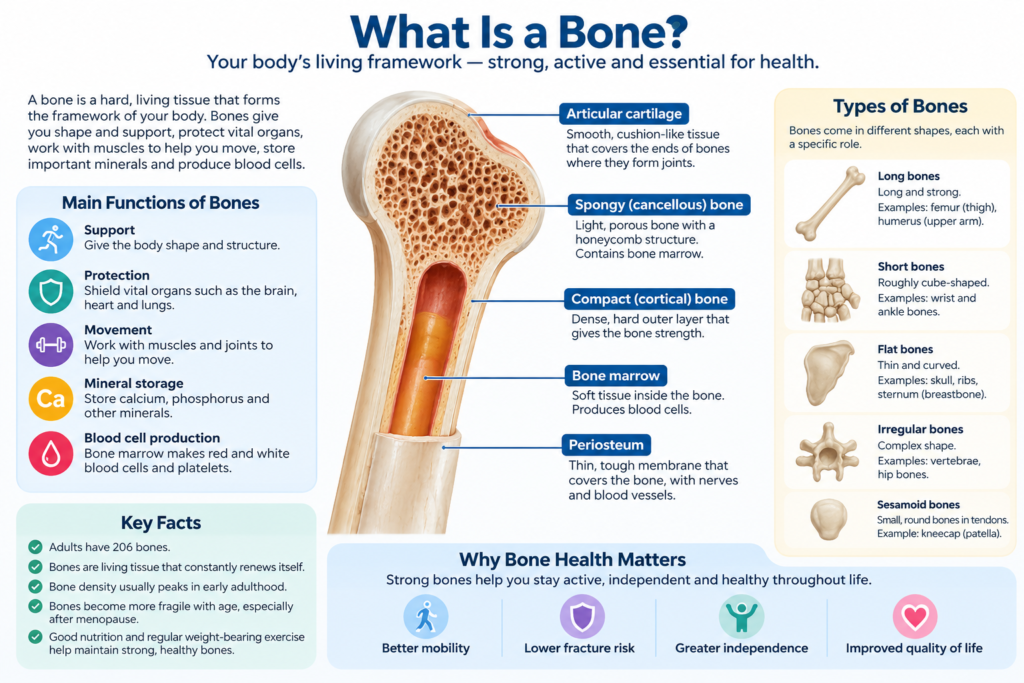
- Cartilage — a smooth, firm tissue that covers the ends of bones and helps them move against each other with less friction.
- Synovial membrane — a thin lining that produces synovial fluid.
- Synovial fluid — a slippery liquid that helps lubricate the joint and reduce friction.
- Ligaments — strong bands of tissue that connect bone to bone and help stabilize the joint.
- Tendons — connect muscles to bones and help produce movement.
- Muscles — provide the force needed to move and support the joint.
- Bones — provide the rigid framework of the joint.


5
Are all joints the same?
No. The body contains different types of joints, depending on how much movement they allow.
Fibrous joints are held together by strong connective tissue and allow little or no movement. The joints between the bones of the skull are examples.
Cartilaginous joints are connected by cartilage and allow limited movement. The joints between some of the vertebrae are examples.
Synovial joints are the most freely movable joints and are the type most commonly associated with arthritis and everyday joint pain. They include the knees, hips, shoulders, elbows, wrists, fingers and ankles.
Which joints are affected most often?
There is no single joint that always becomes painful first. It depends on the condition.
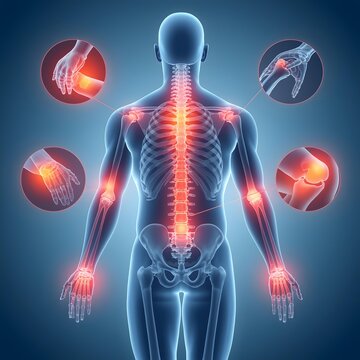
However, the knees, hips and hands are among the joints commonly affected by osteoarthritis, while the spine can also be affected. Previous injuries, repetitive stress, body weight, age and genetics can influence which joints develop problems. (NIAMS)
For inflammatory arthritis such as rheumatoid arthritis, the hands, wrists and feet are commonly affected, and symptoms may occur in several joints at the same time.
In simple terms: joints are the body’s moving connections between bones. They need healthy cartilage, fluid, ligaments, tendons and muscles to move smoothly and remain stable. When one or more of these structures becomes damaged, inflamed or diseased, pain, stiffness, swelling and reduced movement can result.
- ARTHRITIS & JOINT PAIN: SYMPTOMS, CAUSES, TREATMENT & SUPPLEMENTS
- Joint Pain: Causes, Symptoms, Treatment & Supplements That May Help
- Best Joint Support Supplements: Glucosamine vs Collagen vs Hyaluronic Acid
- Best Joint Supplements (2026): What Works and How to Choose (Evidence-Based)
- Best Supplements for Muscle and Joint Pain: What Works and How to Choose
- Best Supplements for Inflammation: What Works and How to Choose