
A Step-by-Step Guide
How to Use Eye Drops Correctly
Eye drops are one of the most commonly used treatments for dry eyes, allergies, glaucoma, infections, inflammation, and many other eye conditions. However, studies show that many people do not use eye drops correctly, meaning that much of the medication never reaches the eye.
Incorrect technique can reduce the effectiveness of treatment, increase the risk of contamination and infection, and sometimes increase the absorption of medication into the bloodstream, potentially leading to unwanted side effects.
Fortunately, learning the correct technique is simple and only takes a few minutes. This guide explains how to use eye drops safely and effectively, as well as common mistakes to avoid.
Why Is Proper Technique Important?
Using eye drops correctly helps:
- Deliver the medication where it is needed.
- Improve treatment effectiveness.
- Reduce medication waste.
- Lower the risk of contamination.
- Minimize side effects caused by absorption into the bloodstream.
- Prevent eye infections.
Even experienced patients sometimes develop habits that reduce the effectiveness of their treatment.
Step-by-Step Guide
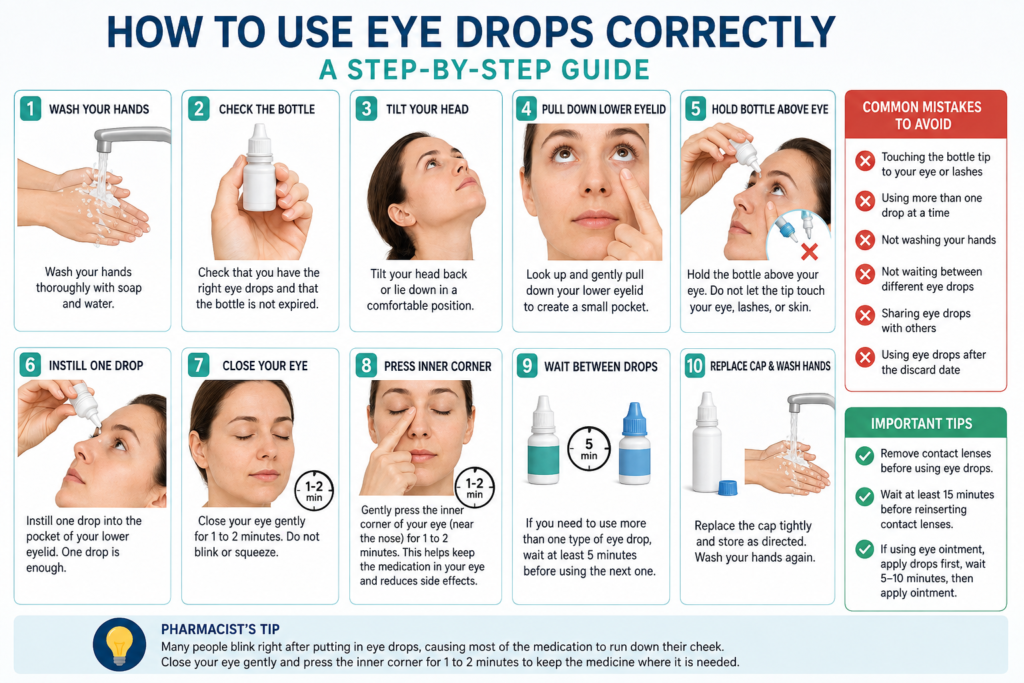
Step 1: Wash Your Hands
Always wash your hands thoroughly with soap and water before handling eye drops.
Dry your hands with a clean towel.
This helps prevent bacteria from entering the eye.
Step 2: Check the Bottle
Before using eye drops:
- Check the label.
- Confirm you are using the correct medication.
- Check the expiry date.
- Make sure the bottle is not damaged.
Never use expired eye drops.
Step 3: Remove Contact Lenses (If Necessary)
Many medicated eye drops should not be used while wearing contact lenses.
Unless your healthcare professional advises otherwise:
- Remove contact lenses first.
- Wait at least 15 minutes before reinserting them, especially if the drops contain preservatives.
If you have an eye infection, do not wear contact lenses until your healthcare professional says it is safe.
Step 4: Tilt Your Head Back
Sit comfortably or lie down.
Tilt your head backward.
Look toward the ceiling.
Step 5: Create a Pocket
Using one finger, gently pull down your lower eyelid.
This creates a small pocket where the drop should be placed.
Avoid pulling the eyelid too forcefully.
Step 6: Hold the Bottle Correctly
Hold the bottle above your eye.
Do not allow the bottle tip to touch:
- Your eye
- Eyelashes
- Eyelids
- Fingers
- Skin
Touching the tip contaminates the bottle and may increase the risk of infection.
Step 7: Instill One Drop
Squeeze one drop into the pocket created by the lower eyelid.
One drop is enough.
The eye can only hold a very small amount of liquid, so using two or three drops at once usually provides no additional benefit.
If the drop misses the eye, simply try again.
Step 8: Close Your Eye Gently
Close your eye gently.
Do not squeeze your eyelids tightly.
Do not blink repeatedly.
Keep your eye closed for 1 to 2 minutes.
This allows the medication to remain on the eye surface for longer.
Step 9: Press the Tear Duct (Punctal Occlusion)
One of the most overlooked—but important—steps is to gently press the inner corner of your eye, next to your nose, for 1 to 2 minutes after applying the drop.
This technique, known as punctal occlusion, reduces drainage of the medication into the nose and throat, helping more of the medicine stay in the eye.
It is especially important when using:
- Glaucoma eye drops
- Corticosteroid eye drops
- Medicated eye drops that may cause systemic side effects
Step 10: Wait Before Using Another Eye Drop
If you use more than one type of eye drop:
Wait at least 5 minutes between medications.
Otherwise, the second drop may wash away the first one.
Step 11: Eye Drops Before Eye Ointment
If your treatment includes both eye drops and an eye ointment:
- Use the eye drops first.
- Wait 5–10 minutes.
- Apply the ointment last.
Eye ointments temporarily blur vision, so they should always be used after eye drops.
Common Mistakes
Many people accidentally reduce the effectiveness of their eye drops.
Avoid:
- Touching the bottle tip to the eye.
- Using several drops at once.
- Blinking repeatedly immediately after application.
- Forgetting punctal occlusion.
- Sharing eye drops.
- Continuing to use bottles beyond their recommended discard date.
- Skipping doses.
- Stopping antibiotics early.
Why Do Eye Drops Taste Bitter?
Many people notice a bitter taste in their mouth shortly after using eye drops.
This happens because the medication drains through the tear duct into the nose and throat.
Although this is usually harmless, it also means that part of the medication has left the eye.
Using punctal occlusion helps reduce this drainage and improves the effectiveness of the treatment.
How Long Can Eye Drops Be Used After Opening?
Many eye drops containing preservatives should be discarded 28 days after opening, unless the manufacturer provides different instructions.
Some preservative-free products are intended for single use only and should be discarded immediately after opening.
Always follow the instructions supplied with your medication.
How Should Eye Drops Be Stored?
Storage instructions vary depending on the product.
Some eye drops should be:
- Stored at room temperature.
- Protected from direct sunlight.
- Kept refrigerated before opening.
Always read the patient information leaflet and follow the manufacturer’s instructions.
Do not expose eye drops to excessive heat or freezing temperatures.
Can Two People Share the Same Eye Drops?
No.
Eye drops should never be shared, even between family members.
Sharing eye drops increases the risk of spreading bacteria, viruses, and other infections.
Each bottle should only be used by one person.
How to Give Eye Drops to Children
Giving eye drops to children can be challenging, particularly in infants and toddlers.
Helpful tips include:
- Wash your hands first.
- Explain the procedure calmly to older children.
- Ask younger children to lie down.
- Gently pull down the lower eyelid if possible.
- If your child refuses to open their eyes, place a drop in the inner corner of the closed eye. When they open their eye, the medication will flow inside.
- Reward younger children afterwards to reduce anxiety during future treatments.
Never force the bottle against the eye.
When Should You See a Doctor?
Seek medical advice if:
- Symptoms worsen.
- Eye pain develops.
- Vision becomes blurred.
- You notice increasing redness or swelling.
- Thick yellow or green discharge appears.
- Symptoms do not improve despite treatment.
- You accidentally injure your eye while using eye drops.
Seek emergency medical attention immediately if you experience:
- Sudden vision loss.
- Severe eye pain.
- Chemical burns.
- Penetrating eye injury.
- Significant sensitivity to light after an injury.
💡 Pharmacist’s Tip
Most people focus on getting the drop into the eye, but what you do afterwards is just as important. Closing the eye gently and pressing the inner corner of the eye (punctal occlusion) for one to two minutes helps the medication stay where it is needed and reduces the amount that drains into the nose and throat. This simple step can improve the effectiveness of many eye drops and reduce the risk of systemic side effects.
Clinical Disclaimer
This article is intended for educational purposes only and should not replace professional medical advice. Always follow the instructions provided by your doctor, pharmacist, or the manufacturer of your eye medication. Seek prompt medical attention if you develop severe eye pain, sudden vision changes, persistent redness, or signs of an eye infection.
Related Articles
- Why Are My Eyes Dry, Itchy and Watery? Dry Eyes vs Eye Allergies
- Why Are My Eyes Red? Pink Eye (Conjunctivitis): Symptoms, Causes & Treatment
- Why Is My Vision Blurry? Common Eye Disorders Explained
- What Should I Do If I Injure My Eye? Eye Injuries, First Aid & Treatment
- Why Does My Eyelid Keep Twitching? Causes, Treatments and Science-Backed Solutions
References
- American Academy of Ophthalmology (AAO). How to Put in Eye Drops Correctly.
- National Eye Institute (NEI). Medicines for the Eye.
- Royal National Institute of Blind People (RNIB). Using Eye Drops.
- NHS. How to Use Eye Drops and Eye Ointments.
- Mayo Clinic. Eye Drops: Proper Technique.
- MSD Manual Professional Edition. Administration of Ophthalmic Medications.
- European Glaucoma Society. Guidelines for Topical Eye Medication Use.