Common Eye Disorders Explained (Myopia, Presbyopia, Cataracts & More)
Why Is My Vision Blurry?
Blurry vision is one of the most common reasons people visit an optometrist or ophthalmologist. It can affect one or both eyes, develop gradually over many years, or appear suddenly. While some vision changes are a normal part of aging, others may be caused by eye diseases that require prompt treatment.
Common causes of blurred vision include myopia (short-sightedness), hyperopia (long-sightedness), astigmatism, presbyopia, cataracts, glaucoma, and age-related macular degeneration. In some cases, blurred vision may also result from dry eyes, diabetes, migraines, medications, or eye injuries.
Understanding the cause of blurred vision is important because early diagnosis can often prevent further vision loss and improve quality of life.
How Does Normal Vision Work?
To see clearly, light must pass through several structures in the eye before reaching the retina, the light-sensitive tissue at the back of the eye. The cornea and the lens work together to focus light precisely on the retina, where it is converted into nerve signals and sent to the brain through the optic nerve.
When the shape of the eye changes or the lens loses its ability to focus, light no longer reaches the retina correctly, causing blurred vision.
As we age, the natural lens also becomes less flexible and less transparent, leading to conditions such as presbyopia and cataracts.
| Condition | Main symptom | Typical age |
|---|---|---|
| Myopia | Blurred distance vision | Childhood to young adulthood |
| Hyperopia | Blurred near vision | Childhood or adulthood |
| Astigmatism | Blurred or distorted vision | Any age |
| Presbyopia | Difficulty reading small print | Over 40 years |
| Cataracts | Cloudy or dim vision | Usually over 60 years |
| Glaucoma | Gradual peripheral vision loss (often no early symptoms) | Usually over 60 years |
| Macular degeneration | Blurred central vision | Usually over 50 years |
Myopia (Short-Sightedness)
Myopia, also called short-sightedness or near-sightedness, is one of the most common vision problems worldwide. People with myopia can usually see nearby objects clearly, but distant objects appear blurred because light focuses in front of the retina rather than directly on it.
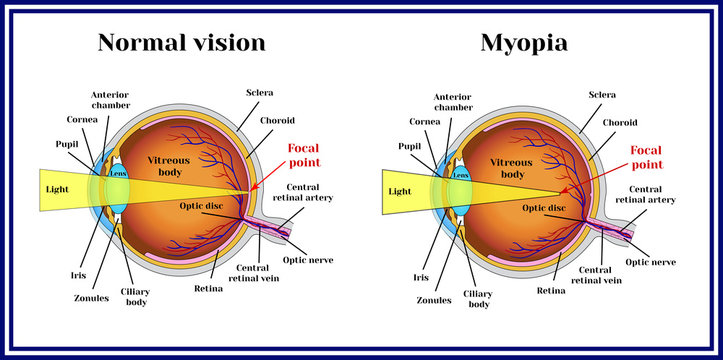
Myopia often develops during childhood or adolescence and may gradually worsen as children grow. Genetics play an important role, but spending long periods doing close-up work and limited time outdoors may also contribute to its development.
Symptoms
Common symptoms include:
- Blurred distance vision
- Squinting to see clearly
- Difficulty seeing road signs
- Difficulty seeing the classroom board
- Frequent headaches
- Eye strain
- Sitting very close to the television
Treatment
Myopia can usually be corrected with:
- Glasses
- Contact lenses
- Orthokeratology lenses (in selected cases)
- Laser eye surgery (LASIK or PRK) for suitable adults
Children with progressing myopia may benefit from specialized treatments recommended by an eye care professional.
Hyperopia (Long-Sightedness)
Hyperopia, also known as long-sightedness or farsightedness, occurs when light focuses behind the retina rather than directly on it. Younger people may compensate by increasing the focusing power of the eye, but this becomes more difficult with age.
People with hyperopia often see distant objects more clearly than nearby objects, although severe hyperopia can blur vision at all distances.
Symptoms
Symptoms may include:
- Blurred vision when reading
- Eye strain
- Headaches after close work
- Difficulty focusing on nearby objects
- Tired eyes
Treatment
Treatment options include:
- Glasses
- Contact lenses
- Refractive laser surgery for selected adults
Children with significant hyperopia should be assessed early because untreated cases may increase the risk of lazy eye (amblyopia) or crossed eyes (strabismus).
Astigmatism
Astigmatism is a common refractive error caused by an irregular curvature of the cornea or, less commonly, the lens. Instead of focusing light at a single point on the retina, the eye focuses light at multiple points, causing blurred or distorted vision.
Astigmatism often occurs together with myopia or hyperopia.
Symptoms
People with astigmatism may experience:
- Blurred or distorted vision
- Difficulty seeing fine details
- Eye strain
- Headaches
- Squinting
- Difficulty driving at night
- Glare around lights
Mild astigmatism may cause few or no symptoms.
Treatment
Most cases can be corrected with:
- Prescription glasses
- Toric contact lenses
- Laser vision correction for suitable adults
Regular eye examinations help ensure that the prescription remains accurate.
Presbyopia
Presbyopia is a normal age-related change that gradually reduces the eye’s ability to focus on nearby objects. Unlike myopia or hyperopia, presbyopia develops because the natural lens becomes less flexible with age, making it harder to focus on close objects such as books, smartphones, or medicine labels.A
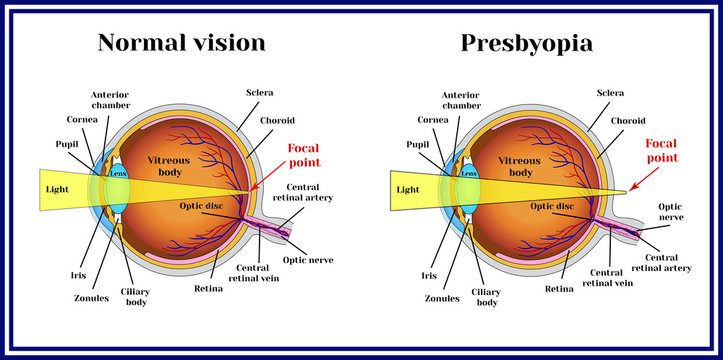
Most people begin noticing symptoms between the ages of 40 and 50 years.
Symptoms
Common symptoms include:
- Difficulty reading small print
- Holding books or phones farther away
- Blurred near vision
- Eye strain when reading
- Headaches after close work
- Needing brighter light for reading
Presbyopia is a normal part of aging and affects almost everyone eventually.
Treatment
Treatment options include:
- Reading glasses
- Bifocal glasses
- Progressive lenses
- Multifocal contact lenses
- Monovision contact lenses
- Refractive surgery in selected cases
Regular eye examinations can help determine the most appropriate correction as vision changes over time.
Cataracts
A cataract is a clouding of the natural lens inside the eye, causing vision to become blurred, cloudy, or dim. Cataracts usually develop slowly with age and are one of the leading causes of vision loss worldwide. Fortunately, cataract surgery is one of the safest and most successful surgical procedures performed today.
Symptoms
Symptoms usually develop gradually and may include:
- Blurred or cloudy vision
- Faded or dull colors
- Difficulty seeing at night
- Increased sensitivity to bright lights or glare
- Halos around lights
- Frequent changes in glasses prescription
- Double vision in one eye
- Needing brighter light for reading
Because cataracts develop slowly, many people do not notice vision changes until everyday activities become difficult.
Risk Factors
The risk of cataracts increases with:
- Aging
- Diabetes
- Smoking
- Long-term corticosteroid use
- Excessive sun (UV) exposure
- Previous eye injuries
- Previous eye surgery
- Family history
Wearing sunglasses that block UV rays and avoiding smoking may help reduce the risk.
Treatment
In the early stages, stronger glasses and improved lighting may temporarily improve vision.
When cataracts interfere with daily activities such as driving, reading, or recognizing faces, cataract surgery is usually recommended. During surgery, the cloudy natural lens is replaced with a clear artificial lens (intraocular lens), restoring vision in most patients.
Glaucoma
Glaucoma is a group of eye diseases that gradually damage the optic nerve, often because of increased pressure inside the eye. If left untreated, glaucoma can lead to permanent vision loss.
One of the most important facts about glaucoma is that it often causes no symptoms in its early stages, which is why regular eye examinations are essential.
Symptoms
Open-angle glaucoma, the most common type, usually develops slowly without pain.
Symptoms may include:
- Gradual loss of peripheral (side) vision
- Difficulty seeing in dim light
- Tunnel vision in advanced stages
Acute Angle-Closure Glaucoma
A much less common but serious form of glaucoma develops suddenly and is a medical emergency.
Symptoms include:
- Severe eye pain
- Sudden blurred vision
- Halos around lights
- Red eye
- Headache
- Nausea and vomiting
Anyone with these symptoms should seek immediate emergency medical care.
Risk Factors
Risk factors include:
- Age over 60 years
- Family history
- Diabetes
- High eye pressure
- African or Asian ancestry (depending on glaucoma type)
- Long-term corticosteroid use
- Severe myopia
Treatment
Treatment aims to reduce eye pressure and prevent further damage.
Options include:
- Prescription eye drops
- Laser treatment
- Surgery in selected cases
Vision already lost from glaucoma cannot usually be restored, making early diagnosis extremely important.
Age-Related Macular Degeneration (AMD)
Age-related macular degeneration is a disease affecting the macula, the central part of the retina responsible for detailed central vision.
AMD mainly affects people over the age of 50 and is one of the leading causes of vision loss in older adults.
Unlike glaucoma, AMD usually affects central vision, while side vision often remains normal.
Symptoms
Symptoms include:
- Blurred central vision
- Difficulty reading
- Distorted straight lines
- Difficulty recognizing faces
- Reduced color perception
- Dark or empty spots in the center of vision
AMD does not usually cause complete blindness because peripheral vision is preserved.
Types
Dry AMD
This is the most common form and usually progresses slowly.
Wet AMD
Wet AMD develops when abnormal blood vessels grow beneath the retina. It progresses more rapidly and requires urgent specialist treatment.
Risk Factors
Risk factors include:
- Aging
- Smoking
- Family history
- High blood pressure
- Obesity
Treatment
Dry AMD has no cure, but healthy lifestyle changes and specific vitamin formulations (AREDS2) may slow progression in selected patients.
Wet AMD is treated with injections of medications that block abnormal blood vessel growth.
Diabetes and Eye Disease
Diabetes can damage the tiny blood vessels inside the retina, leading to diabetic retinopathy, one of the leading causes of vision loss among working-age adults.
High blood sugar over many years increases the risk of retinal damage.
Symptoms
Early diabetic retinopathy often causes no symptoms.
As the disease progresses, people may notice:
- Blurred vision
- Floaters
- Dark spots
- Poor night vision
- Vision loss
Because symptoms may not appear until significant damage has occurred, people with diabetes should have regular dilated eye examinations, even if their vision seems normal.
Prevention
The best way to reduce the risk is by:
- Maintaining good blood sugar control
- Controlling blood pressure
- Managing cholesterol
- Not smoking
- Attending regular diabetic eye screening appointments
When Is Blurred Vision an Emergency?
Although many vision problems develop gradually, some require immediate medical attention.
Seek emergency medical care immediately if you experience:
- Sudden loss of vision in one or both eyes
- Sudden blurred vision
- Double vision that develops suddenly
- Severe eye pain
- Flashes of light accompanied by many new floaters
- A “curtain” or shadow covering part of your vision
- Eye injury
- Chemical exposure to the eye
- Red eye with severe pain and nausea
- Sudden vision changes together with weakness, difficulty speaking, or facial drooping, as these may indicate a stroke
Prompt treatment may help preserve vision.
Diagnosis
An eye care professional can usually identify the cause of blurred vision during a comprehensive eye examination.
Tests may include:
- Visual acuity test to measure how clearly you can see.
- Refraction test to determine the correct glasses prescription.
- Slit-lamp examination to examine the front of the eye.
- Dilated eye examination to inspect the retina and optic nerve.
- Tonometry to measure eye pressure, particularly when glaucoma is suspected.
- Optical coherence tomography (OCT) to produce detailed images of the retina and optic nerve in conditions such as macular degeneration and glaucoma.
- Visual field testing to detect peripheral vision loss caused by glaucoma.
Regular eye examinations become increasingly important with age, especially for people with diabetes, high blood pressure, or a family history of eye disease.
Treatment
Treatment depends on the underlying cause of blurred vision.
Glasses and Contact Lenses
Most refractive errors, including myopia, hyperopia, astigmatism, and presbyopia, can be corrected with prescription glasses or contact lenses.
Laser Vision Correction
Procedures such as LASIK or PRK may reduce or eliminate the need for glasses in carefully selected adults with stable refractive errors.
Cataract Surgery
Removing the cloudy natural lens and replacing it with an artificial intraocular lens is the standard treatment for cataracts.
Prescription Eye Drops
Eye drops may be prescribed for conditions such as glaucoma, allergies, dry eyes, or inflammation.
Injections and Laser Treatment
Some retinal diseases, including wet age-related macular degeneration and diabetic retinopathy, may require injections into the eye, laser treatment, or surgery.
Supplements for Eye Health
A healthy diet rich in fruits, vegetables, and oily fish supports overall eye health. However, supplements are not a substitute for regular eye examinations or medical treatment.
AREDS2 Formula
Specific formulations containing vitamin C, vitamin E, zinc, copper, lutein, and zeaxanthin may slow the progression of intermediate or advanced age-related macular degeneration in selected patients. These supplements are not recommended for everyone and should be used on the advice of an eye care professional.
Lutein and Zeaxanthin
These carotenoids are naturally found in the macula and may help support retinal health. They are also present in leafy green vegetables such as spinach and kale.
Omega-3 Fatty Acids
Omega-3 fatty acids contribute to overall eye health and may be beneficial for some people with dry eye disease, although evidence is mixed.
Vitamin A
Vitamin A is essential for normal vision and helps maintain the health of the cornea. Deficiency is uncommon in developed countries but remains a significant cause of preventable blindness in some parts of the world.
Prevention
Many common eye disorders cannot be completely prevented, but healthy lifestyle habits can reduce the risk of vision loss.
You can help protect your eyesight by:
- Having regular comprehensive eye examinations.
- Wearing sunglasses that block 100% of UVA and UVB rays.
- Stopping smoking.
- Managing diabetes, high blood pressure, and cholesterol.
- Eating a balanced diet rich in leafy green vegetables, fruit, and oily fish.
- Wearing protective eyewear during sports or hazardous work.
- Following the 20-20-20 rule during prolonged screen use (every 20 minutes, look at something 20 feet away for 20 seconds).
- Seeking prompt medical attention for sudden changes in vision.
Vision Problems in Children
Vision problems can affect children of all ages and may interfere with learning, reading, sports, and normal development. Because young children often assume that everyone sees the world the same way they do, they may not realize they have a vision problem.
Regular vision screening and eye examinations are important because many childhood eye conditions can be treated successfully if detected early.
Common Vision Problems in Children
Myopia (Short-Sightedness)
Myopia is becoming increasingly common worldwide and often develops during school age.
Children with myopia may:
- Squint to see distant objects.
- Sit very close to the television.
- Hold books or tablets very close to their face.
- Struggle to read the classroom board.
- Complain of headaches after school.
- Frequently rub their eyes.
Early treatment with glasses, contact lenses (for suitable older children), or myopia control therapies may help slow progression.
Hyperopia (Long-Sightedness)
Mild hyperopia is common in young children and often improves as the eyes grow.
However, significant hyperopia may cause:
- Blurred near vision
- Eye strain
- Reading difficulties
- Crossed eyes (strabismus)
- Lazy eye (amblyopia)
Children with significant hyperopia usually require prescription glasses.
Astigmatism
Astigmatism may cause blurred vision at both near and far distances.
Children may:
- Squint frequently.
- Tilt their head while looking at objects.
- Have difficulty concentrating while reading.
- Develop headaches.
Glasses usually correct the problem effectively.
Lazy Eye (Amblyopia)
Amblyopia develops when one eye does not develop normal vision during childhood.
It may be caused by:
- Strabismus (crossed eyes)
- Significant differences in vision between the two eyes
- Congenital cataracts
- Drooping eyelid (ptosis)
Treatment is most successful when started early and may include:
- Glasses
- Eye patching
- Atropine eye drops
- Treating the underlying cause
Strabismus (Crossed Eyes)
Strabismus occurs when the eyes do not point in the same direction.
Parents may notice:
- One eye turning inward or outward
- Double vision in older children
- Head tilting
- Closing one eye in bright sunlight
Early treatment reduces the risk of permanent vision loss.
Congenital Cataracts
Although cataracts are usually associated with aging, babies can occasionally be born with cataracts.
Parents should seek urgent medical advice if they notice:
- A white pupil
- Poor eye contact
- Eyes that do not follow objects
- Rapid eye movements (nystagmus)
Early treatment is essential for normal visual development.
How Can Parents Protect Their Child’s Vision?
Parents can help maintain healthy eyesight by:
- Scheduling regular eye examinations.
- Limiting prolonged screen time.
- Encouraging outdoor play every day.
- Providing good lighting for reading and homework.
- Encouraging children to wear sunglasses outdoors.
- Ensuring children wear protective eyewear during sports when appropriate.
- Following the 20-20-20 rule during prolonged screen use.
When Should You Take Your Child to an Eye Doctor?
Arrange an eye examination if your child:
- Squints frequently.
- Holds objects very close.
- Complains of headaches.
- Has difficulty reading.
- Frequently rubs their eyes.
- Has one eye that turns inward or outward.
- Has unequal pupils.
- Has a white reflection in photographs.
- Complains of double vision.
- Has sudden changes in vision.
Early diagnosis can prevent permanent vision problems.
💡 Pharmacist’s Tip
Many people assume that blurred vision is simply a sign that they need stronger glasses. While this is often true, blurred vision can also be caused by cataracts, glaucoma, diabetes, macular degeneration, dry eyes, medication side effects, or even a medical emergency such as retinal detachment or stroke. Never ignore sudden changes in your vision, especially if they affect only one eye or are accompanied by eye pain, flashes of light, or severe headaches.
Why is my vision blurry all of a sudden?
Sudden blurred vision may result from an eye injury, retinal detachment, migraine, stroke, glaucoma, or other serious conditions. Because some causes require urgent treatment, sudden vision changes should always be assessed promptly by a healthcare professional.
Why is my distance vision blurry?
Difficulty seeing distant objects is most commonly caused by myopia (short-sightedness), although cataracts and other eye conditions can also contribute.
Why can’t I read small print anymore?
Difficulty reading small print after the age of 40 is usually caused by presbyopia, a normal age-related change in the eye’s focusing ability.
What is the difference between myopia and hyperopia?
People with myopia see nearby objects clearly but struggle with distant vision. People with hyperopia often have difficulty focusing on nearby objects, particularly as they get older.
Can cataracts be prevented?
Although cataracts cannot always be prevented, not smoking, protecting your eyes from ultraviolet (UV) light with sunglasses, managing diabetes, and maintaining a healthy lifestyle may help reduce your risk.
Can glaucoma cause blindness?
Yes. If left untreated, glaucoma can lead to permanent vision loss. Regular eye examinations are important because early glaucoma often causes no symptoms.
Can diabetes affect eyesight?
Yes. Diabetes can damage the blood vessels in the retina, leading to diabetic retinopathy. Good blood sugar control and regular diabetic eye screening help reduce the risk of vision loss.
Are eye supplements worth taking?
Most people can obtain the nutrients needed for healthy eyes through a balanced diet. However, AREDS2 /Age related eye degeneration/ supplements may help slow the progression of certain stages of age-related macular degeneration when recommended by an eye specialist.
Can children develop vision problems?
Yes. Myopia, hyperopia, astigmatism, amblyopia, and strabismus commonly affect children. Early diagnosis is important because treatment is usually more effective while the visual system is still developing.
When should I worry about blurred vision?
Seek immediate medical attention if blurred vision develops suddenly, affects only one eye, occurs together with severe eye pain, flashes of light, a curtain-like shadow over your vision, double vision, or symptoms of a stroke.
Clinical Disclaimer
This article is intended for educational purposes only and should not replace professional medical advice, diagnosis, or treatment. Blurred vision and other vision changes may have many causes, ranging from simple refractive errors to serious eye diseases and medical emergencies. Seek immediate medical attention if you experience sudden vision loss, severe eye pain, flashes of light, a curtain-like shadow across your vision, eye injury, chemical exposure, or vision changes accompanied by weakness, difficulty speaking, or facial drooping. Always consult an optometrist, ophthalmologist, or other qualified healthcare professional for persistent or unexplained vision problems.
Related Articles
- Why Do My Eyes Feel Dry? Dry Eye Syndrome: Symptoms, Causes & Treatment
- Why Are My Eyes Itchy? Eye Allergies (Allergic Conjunctivitis): Symptoms, Causes & Treatment
- Why Are My Eyes Red? Pink Eye (Conjunctivitis): Symptoms, Causes & Treatment
- What Should I Do If I Injure My Eye? Eye Injuries, First Aid & Treatment
- Why Am I Dizzy? Causes, Symptoms & Treatment
- Why Do I Have a Headache? Causes, Symptoms & Treatment (future article)
- Diabetes: Symptoms, Causes & Management (future article)
References
- American Academy of Ophthalmology (AAO). Refractive Errors, Cataracts, Glaucoma and Macular Degeneration.
- National Eye Institute (NEI). Healthy Vision and Common Eye Diseases.
- American Optometric Association (AOA). Comprehensive Eye and Vision Examination.
- National Institute for Health and Care Excellence (NICE). Glaucoma: Diagnosis and Management.
- National Institute for Health and Care Excellence (NICE). Cataracts in Adults: Management.
- American Diabetes Association. Standards of Care in Diabetes – Eye Disease.
- Age-Related Eye Disease Study Research Group (AREDS2). Nutritional Supplements for Age-Related Macular Degeneration.
- Mayo Clinic. Myopia, Hyperopia, Astigmatism, Presbyopia, Cataracts, and Glaucoma.
- MSD Manual Professional Edition. Common Eye Disorders.
- Merck Manual Consumer Version. Vision Disorders and Eye Diseases.